








Agronometrics in Charts: US apple production to drop by seven percent in 2026/27



Each week, the series ‘Agronometrics In Charts’ examines a different horticultural commodity, focusing on a specific origin or topic and visualizing the trade market factors driving change. Check out our entire archive.


United States apple production is forecast to fall seven percent in the 2026/27 crop year to approximately 263 million bushels, according to the 2026 Industry Outlook report from industry body USApple.
The forecast, which combines US Department of Agriculture estimates with USApple analysis for states not covered by the annual USDA survey, is also three percent below the five-year average. Because not all regions took part in this year's adjustment process, the grower organization is not publishing a final industry-adjusted national estimate for 2026/27.
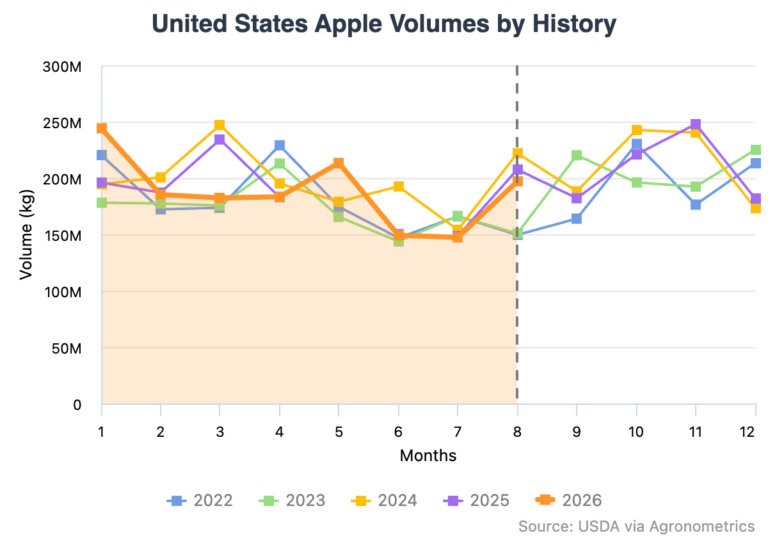
Source: USDA Market News via Agronometrics.
The projected crop is expected to have a farm-gate value exceeding $3 billion, although production prospects vary considerably by region.
"The story this season really varies by region," said Chris Gerlach, USApple vice president and author of the report. While conditions have improved in areas that experienced drought last year, parts of the Mid-Atlantic have faced significant weather-related challenges that are expected to weigh on production.

According to USDA's figures, Washington will remain the leading US apple-producing state, with an estimated 176 million bushels, down two percent from the previous season and valued at more than $2 billion. New York is forecast to produce 32 million bushels, down 10 percent, while Michigan is projected at 25 million bushels, a one percent decline.
The sharpest reductions are expected in Pennsylvania and Virginia, where spring freeze damage is projected to cut production by 58 percent and 48 percent, respectively. Where states submitted their own estimates, they diverge from USDA: USApple puts New York at 29 million bushels and Virginia at 1.3 million, while Michigan's industry representatives said USDA's figure is too low without offering an adjusted number.
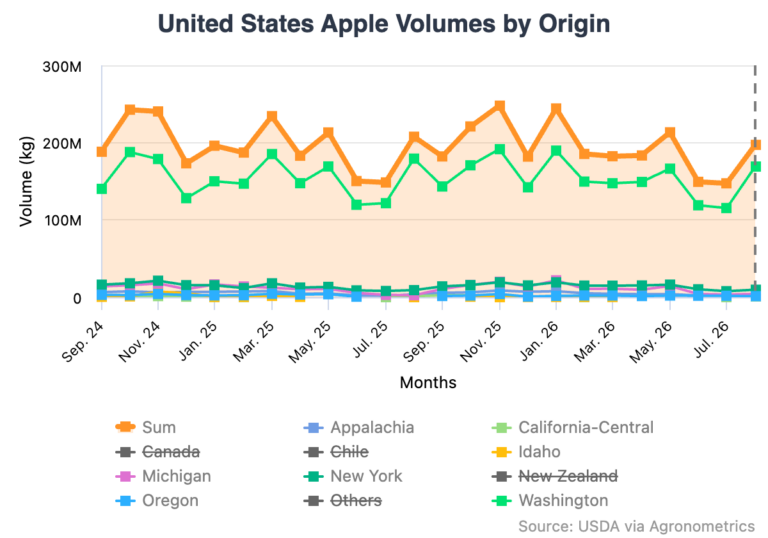
Source: USDA Market News via Agronometrics.
Changing varietal mix
Gala is expected to remain the leading US apple variety, with production approaching 42 million bushels, equivalent to about 16 percent of total domestic supply. Red Delicious is forecast at approximately 30 million bushels, followed closely by Granny Smith, also near 30 million.
The varietal mix continues to shift, reflecting changing consumer preferences and market conditions. Over the past five years, production of Granny Smith, Honeycrisp, Cosmic Crisp and Pink Lady/Cripps Pink has increased, while Gala, Red Delicious and Fuji production has declined.
The industry enters the season after a difficult 2025/26 marketing environment. US growers produced another large crop well above the five-year average, while flat domestic demand and exports below historical levels contributed to low farm-gate prices for many varieties. Rising production costs further pressured grower margins.
Exports remain critical for US apple growers
International markets remain an important outlet for US apples. Fresh apple exports during the 2025/26 crop year reached nearly 45 million bushels, up two percent year-on-year, while imports fell 12 percent to approximately 4 million bushels. This produced a trade surplus of nearly 41 million bushels, valued at more than $1 billion.
Mexico and Canada were the two largest export markets, accounting for 39 percent and 19 percent of US fresh apple exports, respectively. Combined, they purchased nearly $650 million worth of US apples.
Gerlach said growth in both markets was encouraging while emphasizing the importance of maintaining stable trading relationships and developing additional high-value export markets.
*Main photo is referential via Shutterstock | Graphs courtesy of Agronometrics
Related stories
US-India trade deal: Tariffs slashed on Indian exports, new access for US apples and nuts
US apple industry rallies for legislative relief as labor costs reach critical levels











Subscribe to our newsletter