



JBT Marel’s flowable wax promises to streamline pineapple packing operations
 Add Fresh Fruit Portal to Google
For the pineapple industry, protecting fruit quality from packinghouse to supermarket is a key process that must begin with the right protocols. However, even a product designed for this purpose can create its own challenges and labor friction.
JBT Marel set out to address that very issue with Sta-Fresh Flowable Wax 4000, a liquid formulation designed to simplify operations while ensuring that pineapples retain their color and appearance during critical transit times.
Product Line Director Fernando Edagi told FreshFruitPortal.com that development began with feedback from customers who valued the performance of its predecessor, Sta-Fresh 2952, but wanted a product that was easier to apply.

Spray nozzle.
“One of the things our customers complained about was that it wasn't flowable. It was more like a paste, making it hard to handle,” he noted. “An operator would have to put on gloves, personal protective equipment, and everything else just to scoop that paste out of the drums.”
The firm’s research and development team worked on the project for about two years before bringing it to trials, Edagi said. Rather than relying solely on laboratory results, the company tested the product on commercial packing lines, where established partners helped evaluate its performance under real operating conditions.
Edagi said another concern was making the transition as straightforward as possible. With the new, flowable wax, packers can use the same equipment they already have, rendering investments in packinghouse infrastructure unnecessary.
A flowable solution
The difference between the two formulations becomes clear at the packing line. Sta-Fresh 2952 came as a paste that workers had to remove manually from 55-gallon drums. They then needed to dilute it with water and mix it before application, adding handling steps and creating ergonomic challenges, Edagi noted.
In contrast, Sta-Fresh Flowable Wax 4000 eliminates much of that hassle. Workers can pump the liquid directly from the drum to a mixing device, such as JBT Marel’s ProDose pineapple system.
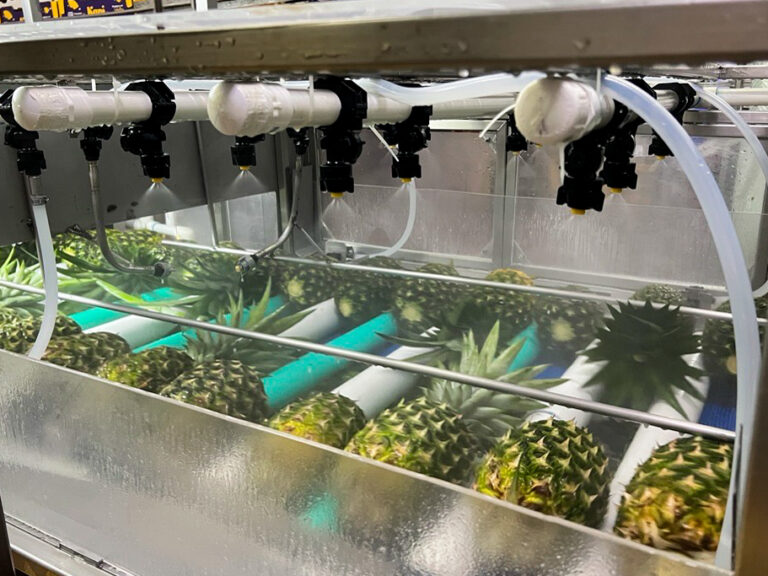
Product application.
The formulation also increases solids concentration from 70 percent in the previous product to 77 percent in the new one. Edagi said that difference affects how much fruit packers can treat per drum, as well as how much product they must transport and store.
“One drum of Sta-Fresh 4000 is equivalent to two drums of our competitor's wax,” he noted.
He said that higher concentration may potentially offset a higher purchase price by reducing freight requirements, inventory volumes, and warehouse space.
For exporters, the value of a postharvest treatment becomes apparent well beyond the packing line. Fruit must retain its appearance through shipping, storage, and distribution, with different markets placing different demands on the product.
“Dehydration and overripening cause sunken spots on the pineapple's skin, which retailers strongly reject,” the expert noted.
The company works with packinghouse partners in Costa Rica, a major pineapple market for JBT Marel, to test new formulations on commercial lines. Much of the country's fruit travels to the United States and Europe.
To assess performance over time, JBT Marel also keeps samples in Costa Rica under cold-storage conditions designed to simulate a long sea shipment. For example, two and a half weeks in cold storage allows the company and its partners to examine how the fruit looks after a comparable transit period.
“And those were the moments when we saw very good performance from our Sta-Fresh 4000; really holding the color, preventing dehydration, and maintaining the overall appearance of the pineapple extremely well,” Edagi stressed.
The company's broader postharvest portfolio includes citrus, pomegranates, sweet potatoes, cherries, apples, and pineapples. JBT Marel is exploring opportunities to extend its technologies to other crops, including mangoes, although Edagi said no product is currently ready for commercial sale for that application.
For Edagi, the work achieved with Sta-Fresh Flowable Wax 4000 reflects what he describes as the wider purpose of postharvest technology: helping growers, packers, exporters, and retailers preserve the value of their hard work as the fruit moves through the supply chain.
*All images and video courtesy of JBT Marel.
Related stories
Mexican mango faces the great postharvest challenge: quality as a passport to conquer the world