Five unique citrus varieties ready to thrive in the Golden State

 Add Fresh Fruit Portal to Google
California growers and citrus enthusiasts looking to bring a fresh squeeze to the category have an unusual lineup of candidates, writes University of California Division of Agriculture and Natural Resources (UC ARN) author Michelle McNeil.
Beyond Meyer lemons and navel oranges, the caviar-like finger limes, the intensely fragrant Buddha's Hand, tart yuzu, and the cold-hardy Flying Dragon show potential to adapt to the Golden State’s climate, the expert says.

However, growers must consider phytosanitary risks, so caution is advised before planting. California prohibits bringing out-of-state citrus trees or seeds because of the risk of spreading citrus greening disease, also known as Huanglongbing (HLB). The malady threatens both commercial citrus production and backyard trees.
The expert recommends planting in early spring to give trees time to establish before winter. According to McNeil, growers can use light applications of balanced fertilizer in spring, with the final applications completed by June. This timing allows growth to slow and harden before the onset of winter frost or freezes.
Cold tolerance: The key to a thriving citrus grove
The five varieties highlighted by McNeil differ substantially in their ability to withstand winter temperatures, a feature that can make or break a grower’s crop.
Nagami kumquat is among the most cold-tolerant and productive options. The evergreen tree produces small orange fruit that can be eaten whole, including the skin, flesh, and seeds. They can withstand temperatures as low as 19 degrees Fahrenheit and can be used fresh, in preserves and marmalades, or as a garnish. The trees also grow well in containers, allowing growers to move them to a warmer location during cold weather.

An evergreen tree with prominent thorns, Yuzu is similarly hardy to 19 degrees Fahrenheit. It produces bumpy, tangerine-sized fruit with numerous seeds. Its highly tart flavor is described as a combination of grapefruit, mandarin, and lemon.
While the fruit is rarely eaten fresh, its juice and peel can be used in beverages such as traditional Japanese sake, as well as in sauces, desserts, and other preparations.
Flying Dragon, a deciduous form of trifoliate citrus, is the most cold-tolerant of the group. Its contorted branches and curved thorns give the tree its name, while its corkscrew growth habit provides an ornamental feature during winter. It can withstand temperatures from 0 to -10 degrees Fahrenheit.
The variety is primarily used as a dwarfing rootstock for edible citrus. It also produces roughly two-inch, bumpy yellow fruit with extremely sour juice that is generally not considered edible. In China, the trees can also serve as thorny hedges.
Finger lime and Buddha's Hand require considerably more protection from cold. Finger lime can handle temperatures only as low as 28 degrees Fahrenheit and may lose leaves and fruit after exposure to light frost.
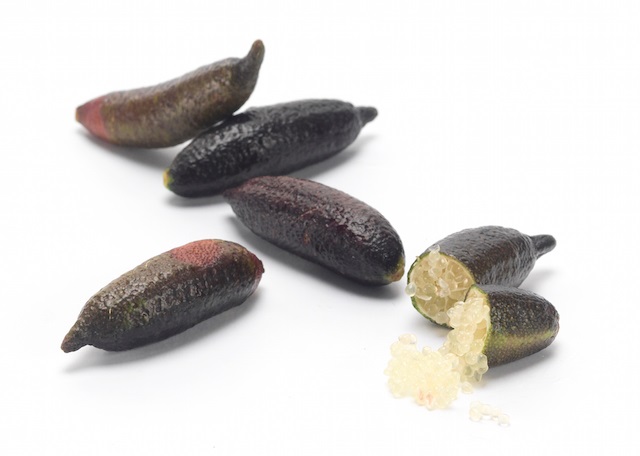
The long, narrow finger lime fruit contains small, tart vesicles that resemble caviar, earning it the nickname "citrus caviar." The pearls can be used as a garnish for savory dishes, desserts, and cocktails. Different varieties produce green, red, or yellow fruit, which can be frozen for later use.
The more widely known Buddha's Hand is even more frost-sensitive, with a minimum temperature tolerance of 32 degrees Fahrenheit. The fruit consists almost entirely of peel, with no seeds or juice, and develops finger-like segments that resemble an open or closed hand.
Its size ranges from 6 to 12 inches long and is used for zest, candying, marmalades, sauces, marinades, and cocktails. Its strong fragrance also makes it suitable for scenting applications.
*All body images are referential via Unsplash | Main image by Michelle McNeil.
Related stories
Finger limes: The challenging journey behind the “citrus caviar”