Unlocking the bitter pit mystery: North and South American researchers unite to tackle costly apple disorder
 Add Fresh Fruit Portal to Google
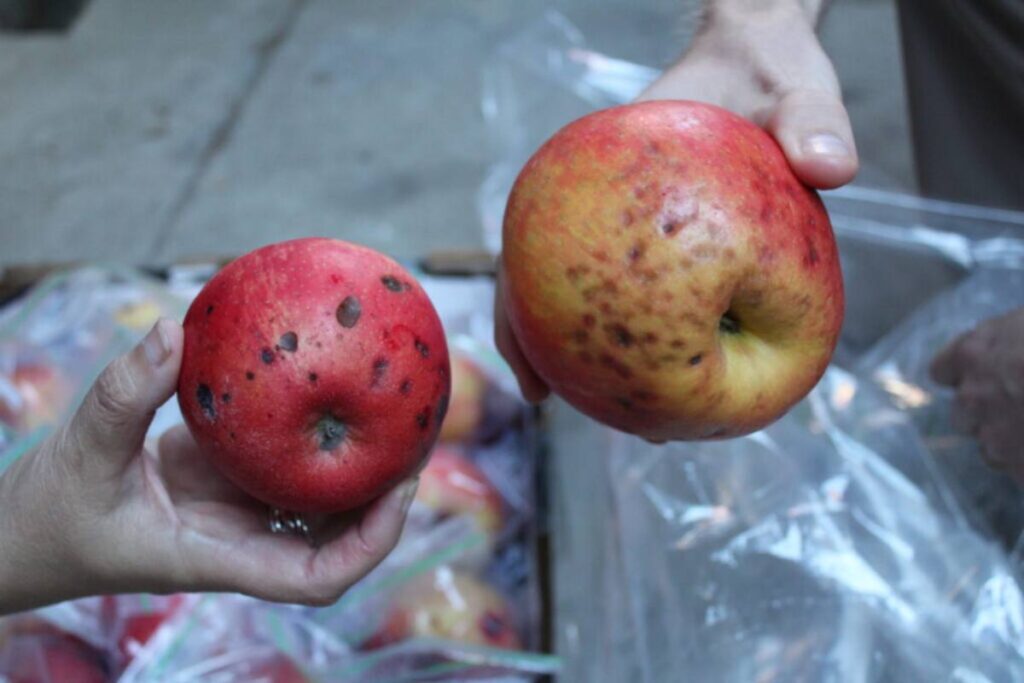
Apple producers have long been battling bitter pit, a stubborn post-harvest disorder causing dark, sunken spots on the fruit's surface, rendering the flesh underneath dry and inedible.
But even though it has been documented for over 150 years and it can cause fruit losses of up to 60 percent in susceptible varieties such as Honeycrisp or Granny Smith, we still don’t fully understand what causes bitter pit nor how to prevent it.
Now, a pioneering international collaboration between researchers at Michigan State University (MSU) and the University of Talca in Chile is searching for answers. Using a state-of-the-art X-ray fluorescence scanning scope, MSU post-harvest physiology professor Randy Beaudry and his team are looking beyond calcium levels as a potential culprit of bitter pit and centering on the role of the mineral’s distribution and concentration within the fruit.
“This would be the first instance where those fruits have been imaged,” Beaudry told FreshFruitPortal.com. “Now we can look at the whole apple and really get an idea of the distribution.”
Bitter pit: The truth beyond the peel
Previous bitter pit research relied on highly localized imaging and probing. But these techniques are far from perfect: the former provides a limited view of the fruit tissue, while the latter is destructive and can only take single-cell samples. Not to mention that both methods are expensive and take weeks to yield results, making them inapplicable to use commercially in the orchard.
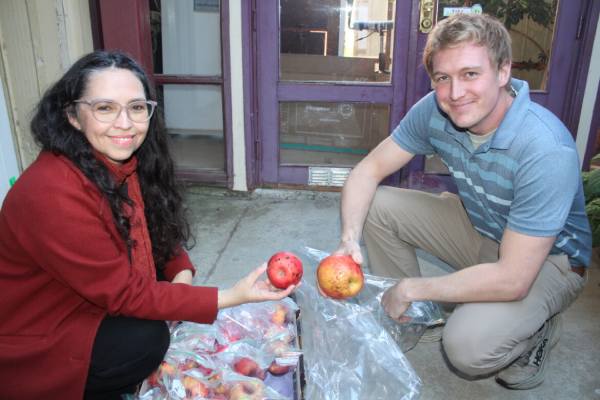
Carolina Contreras and Alex Engelsma, during a trip to the Los Ríos region to collect samples.
During a visit to the University of Talca years ago, Beaudry suggested the use of X-ray fluorescence technology to get a more comprehensive view of bitter pit development.
“I suggested the university get an instrument that could make these measurements, and they eventually got this half-million-dollar machine for their phenomics institute,” he explained.
The scope can help researchers see which minerals, such as calcium, potassium, or iron, are present on the surfaces and interiors of fruit, and where, allowing them not only to identify these elements but also to learn their concentration and distribution within the fruit. Crucially, the machine also cuts processing times down to just 30 minutes, depending on the type of scan, enabling researchers to track mineral movement chronologically from early fruit development to final commercial harvest.
“As far as I know, this very rare and expensive piece of equipment only exists in one place in the world in an ag-related department—and that’s at the University of Talca,” added the academic.
The machine opened the doors for Beaudry’s research, but he had a problem: bitter pit is more prevalent in certain apple varieties, none of them grown close to the University of Talca. That’s when he recruited Carolina Contreras, a post-harvest physiologist and his former graduate student.
Conveniently, Contreras is now a professor at the Faculty of Food and Agrarian Sciences at Universidad Austral de Chile, in the Los Ríos region. There, the major local fruit-producing company, Frusan, grows Honeycrisp apples, one of the most susceptible varieties to bitter pit. Contreras became the project’s liaison in Chile, working with the company to provide multiple samples across various seasons.
Complementing the macro-level imaging study, Alex Engelsma, a second-year PhD student at Beaudry’s lab, is investigating the role of the fruit's internal plumbing system, known as the vasculature. Using a bright pink dye to stain the tissue, the researcher is assessing the functionality of these vital pathways and their role in the incidence of bitter pit.
The long innovation pipeline separating lab and orchard
Bitter pit develops somewhere between right before harvest and during long storage, which is why it never reaches consumers. However, the financial impacts of this disorder are significant, as fruit losses occur after large investments in pesticides, fertilizers, irrigation, and cold storage have already been made.
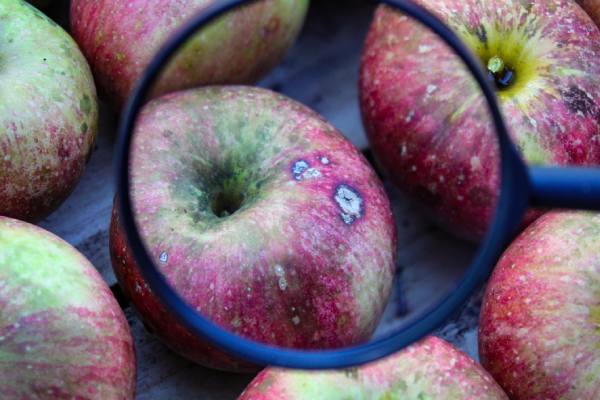
Referential image.
“You could lose between 10 percent and 60 percent of your fruit," Beaudry warned, adding the situation becomes even more dire when considering that most agronomic enterprises survive on razor-thin profit margins of around three percent.
In Chile, Contreras said, Frusan calculates crop losses between 15 percent and 30 percent.
Beaudry is looking into the correlation between calcium concentration and distribution patterns in both leaf and fruit tissue. The hope is to find a link that could eventually lead to easy bitter pit detection using leaves as samples.
“I hope to inspire a service for rapid, low-cost tissue analysis using X-ray fluorescence," he said.
He added that creating such a tool would yield direct financial benefits, as current tests take weeks and cost between $15 and $20 per sample. Meanwhile, for the same cost, this technology can analyze over 100 leaf samples, with next-day or even same-day results.
Beaudry is currently processing his data and hopes to publish results by the end of the year. He's currently also under a Chilean government-awarded Fondecyt grant to study blueberry nutrition with researchers at the University of Talca.
Engelsma, also supported by multiple funds from Chilean institutions, is entering the data analysis stage of his investigation, which is set to start in July. The publication timeline for his study is still to be determined.
*All images courtesy of Universidad Austral de Chile.
Related stories
Chilean blueberry research seeks to boost health benefits and improve quality