Agronometrics in Charts: Erratic weather cuts Mexican strawberry exports by 14 percent

 Add Fresh Fruit Portal to Google
Each week, the series ‘Agronometrics In Charts’ examines a different horticultural commodity, focusing on a specific origin or topic and visualizing the trade market factors driving change. Check out our entire archive.
This year's Mexican strawberry export campaign has volumes down 14 percent year-on-year, an outcome the sector attributes squarely to an unpredictable season in the field.
Juan José Flores García, Managing Director of berry exporters' association Aneberries, told Hortidaily that the difficulties were apparent from the opening weeks. Off-pattern rainfall and a stretch of cold weather, short of frost, but cold enough to matter, took a toll on both how much fruit was available and how well it graded.
Growers responded by putting less ground into production, and shipments fell as a result.
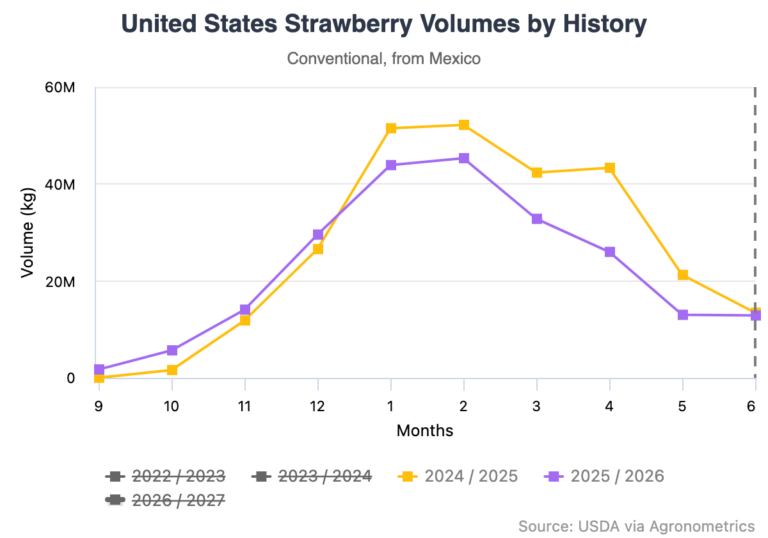
Source: USDA Market News via Agronometrics.
Currency movements sharpened the squeeze. The peso's run against the US dollar was, in García's words, "far from favorable" for producers, eroding the returns exporters banked over the season.
Asked where the industry should be directing capital, Flores García pointed to plant material. The bulk of what goes into Mexican fields is sourced from California, with smaller volumes coming from Spain and from domestic nurseries. Everything downstream, he argued, rests on secure access to healthy, high-performing propagation material varieties with disease resistance, tolerance of erratic weather, and better water efficiency.

A bigger adjustment the Mexican strawberry sector
Behind the season's figures sits a longer structural adjustment. Planted area has come down from roughly 49,000 acres in earlier campaigns to around 37,000 acres, a contraction that has eased demand on the labor pool. Michoacán, Guanajuato, and Jalisco remain the anchors of production in central Mexico, while San Quintín and Ensenada, in Baja California, lead in the north.
For the season ahead, he declined to put numbers on the table, noting that planting is still underway. He expects the area to land close to recent years, with any expansion staying below double digits.
Even with weather, currency, and trade pressures stacked together, he said, Mexico will continue to hold its place as a core supplier of fresh berries to North America, filling gaps in US and Canadian production.
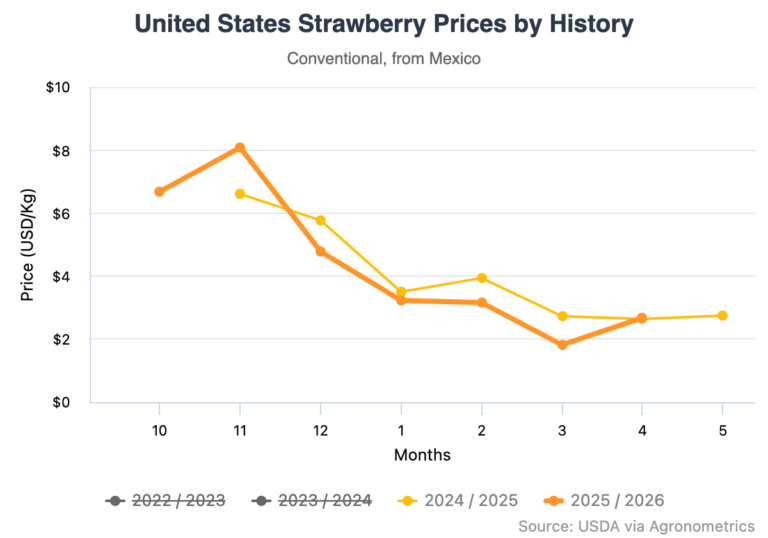
Source: USDA Market News via Agronometrics.
* Images are referential via Unsplash | Graph courtesy of Agronometrics
Related stories
Mexican strawberry industry calls for caution amid US antidumping probe
Florida growers launch antidumping petition against winter Mexican strawberry imports
Mexican strawberry antidumping case continues after big February win for US producers