Non-toxic fungi bactericide shows promise against Neopestalotiopsis in strawberries
 Add Fresh Fruit Portal to Google
A destructive pathogen wreaking havoc in the world’s strawberry fields has seemingly found a worthy opponent. GotaBlanca 500, a silver-based fungicide developed by Costa Rican agtech ClearLeaf, is joining the fight against Neopestalotiopsis and boosting production all in a single application.
First striking Florida strawberry harvests during the 2018/19 season, the aggressive strain wiped out entire fields for some growers, causing millions of dollars in lost revenue.
GotaBlanca is currently registered for use or sale in select international markets, but it is yet to be registered with the Environmental Protection Agency (EPA) for sale, distribution, or commercial use within the United States or its territories.
However, Chief Scientific Officer Agustín Büchert told FreshFruitPortal.com that the product is already delivering encouraging results.
The company is collaborating with the University of Florida’s Gulf Coast Research and Education Center (GCREC) to evaluate the product as a standalone treatment against the pathogen, which can destroy foliage, cause lesions on the fruit’s flesh, and attack the plant’s internal crown tissue, causing it to decay completely.
GotaBlanca’s results are set to provide much-needed relief for strawberry growers facing disease pressure during harvest.
The GotaBlanca difference
With fungal pathogens such as Neopestalotiopsis, growers often turn to systemic fungicides that act from inside the crops. This works particularly well in wet climates such as the Sunshine State’s, as no amount of rain can flush the active out once it’s moving through the plant’s vascular system. But this often leads to other problems.
“That same property is the source of everything growers complain about downstream: the residue in the fruit, the pre-harvest interval, the metabolic load on the plant, and the single-site mode of action that resistance eventually finds,” Büchert explained.
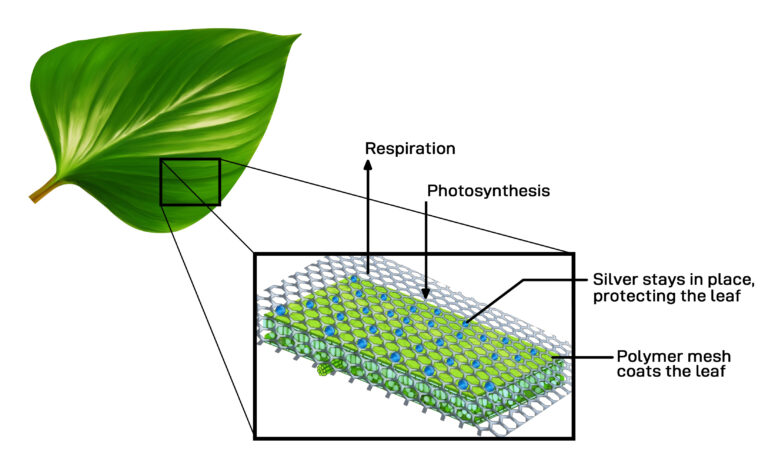
This is why ClearLeaf developed GotaBlanca around a proprietary copolymer system that holds elemental silver on the plant surface, thus solving the “wash-off” conundrum.
“It self-assembles into a microfilm as the spray dries, anchoring to the plant surface and holding the silver in place while still letting the leaf breathe and photosynthesize normally,” he detailed.
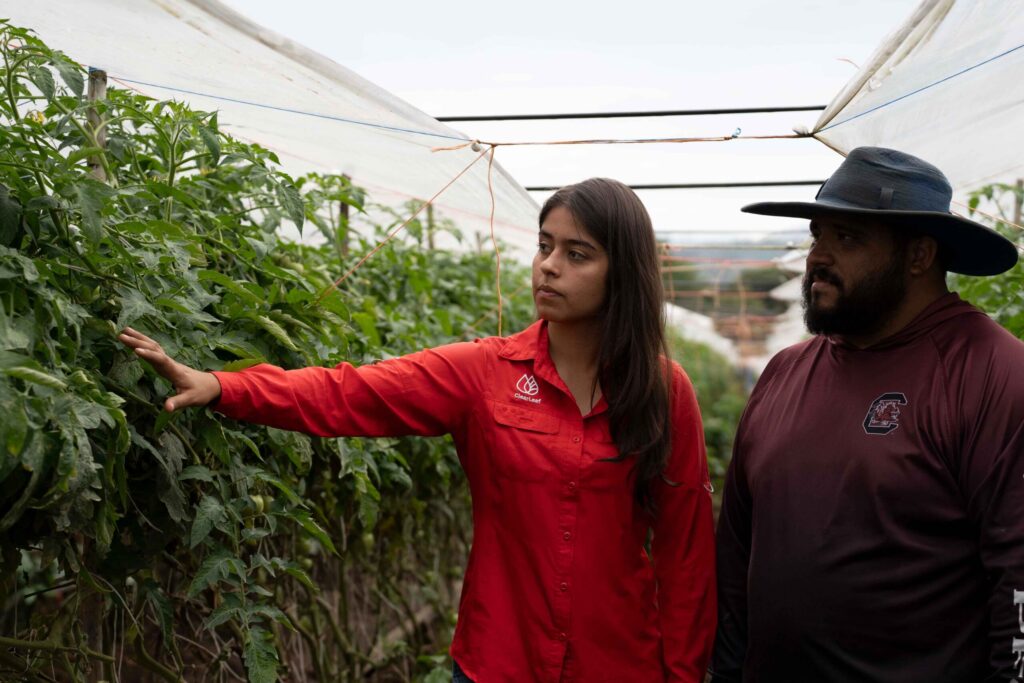
The GCREC trial subjected plants to 10 consecutive days of intermittent overhead irrigation, followed by additional water sprinkling for frost protection when hard freezes arrived. Applications ran weekly from late November through mid-March.
The product works across a pH range of 5 to 9 and, because it contains its own sticker and spreader system, eliminates the need for growers to add a separate wetting agent.
“GotaBlanca went on alone, with no partner product behind it, and it held fruit rot well below the untreated control and delivered a significant yield gain over it,” Büchert said.
ClearLeaf recommends reapplication every 10 to 15 days, and weekly when pressure is high. Büchert cautioned that growers should sequence applications when using microbial biologicals because silver can also affect beneficial microorganisms. However, he stressed that the application is safe for commercial crops.
“In the markets where we are registered, GotaBlanca carries no pre-harvest interval (PHI) and effectively no re-entry restriction,” he said. “In practice that means you can spray a block in the morning and pick it the same day.”
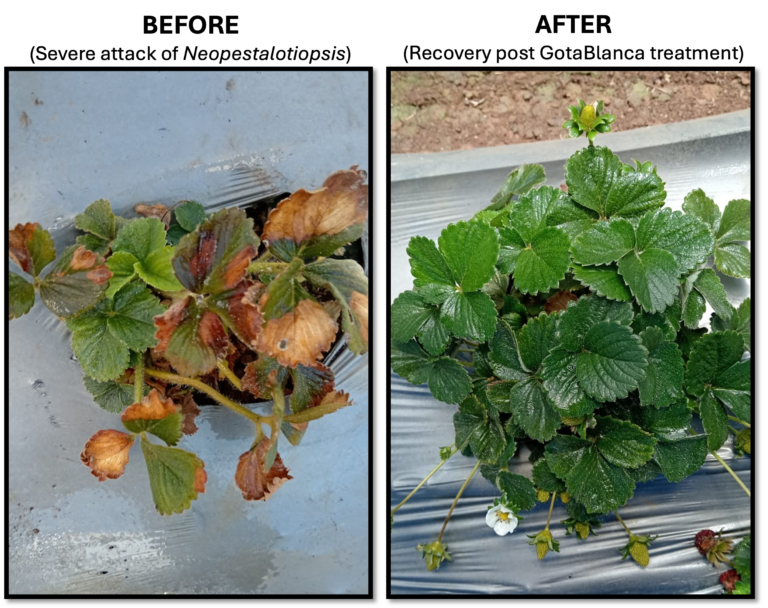
GotaBlanca 500 application results in Costa Rican strawberry fields.
ClearLeaf’s products are currently available for purchase in their native Costa Rica, Panama, Nicaragua, Honduras, and Guatemala.
Büchert said independent laboratory analysis conducted under European Union import protocols found no detectable residues on treated bananas, pineapples, coffee, peaches, and cucumbers.
For strawberries, the operational benefit could be even more significant because growers often harvest blocks every two or three days. Conventional spray programs can require growers to work disease-control applications around harvest timing, potentially narrowing treatment windows during wet periods.
“With GotaBlanca, the two calendars become independent. You spray on disease risk rather than on harvest logistics,” Büchert added.
Additionally, the product itself does not require personal protective equipment, although growers must follow the health prevention requirements of any conventional pesticide.
A cost-effective agent
In separate trials conducted in partnership with Cornell AgriTech, Büchert said GotaBlanca provided 86 percent control of grape downy mildew as a standalone treatment and more than 89 percent in rotation. On grape Botrytis, he said it provided 42 percent control of incidence alone and 40 percent when rotated with biologicals, compared with 35 percent for the grower standard. But there’s more.
“In coffee, we replaced a three-product system costing $86 per hectare per year with GotaBlanca at $76. In onions, we replaced two fungicide and bactericide combinations costing $59 per hectare with $46. In Panamanian rice, we replaced a bactericide, a botanical fungicide, and chlorothalonil with a single application at lower total cost,” he noted. “Consolidation is where the money is, not the price per liter.”
From Florida fields to global markets
ClearLeaf is pursuing additional trials as it expands the product’s crop and geographic footprint. The company said GotaBlanca has been validated across more than 50 plant pathogens and 50 crops.
Büchert added strawberry growers in Latin American markets already use GotaBlanca against Neopestalotiopsis, and he characterized repeat purchases as an important indicator of commercial performance.
“This evidences that this is not just a Florida problem. It is a nursery and transplant problem that has spread through the Americas, and it travels wherever plants travel,” the expert explained.
The firm is conducting a second year of trials with Cornell AgriTech in 2026 across apples, grapes, and vegetables. Prospective partners in Australia and South Africa are also conducting local suitability studies involving strawberries and grapevines, alongside citrus, avocado, and fruiting vegetables, Büchert said.
ClearLeaf is separately developing GotaBlanca Post-Harvest, which the company says can be applied as a spray or dip in existing packhouse operations. The product has been validated on crops including bananas, pineapples, melons and strawberries.
For the US market, ClearLeaf is currently working with regulatory specialists on the registration process. GotaBlanca is not currently registered for sale, distribution, or commercial use within the United States or its territories.
* Images courtesy of ClearLeaf.
Related stories
A vaccine for trees: The new virus-powered weapon joining the fight against HLB