Agronometrics in Charts: What California's early grape season means for the fall handover
 Add Fresh Fruit Portal to Google
Each week, the series ‘Agronometrics In Charts’ examines a different horticultural commodity, focusing on a specific origin or topic and visualizing the trade market factors driving change. Check out our entire archive.
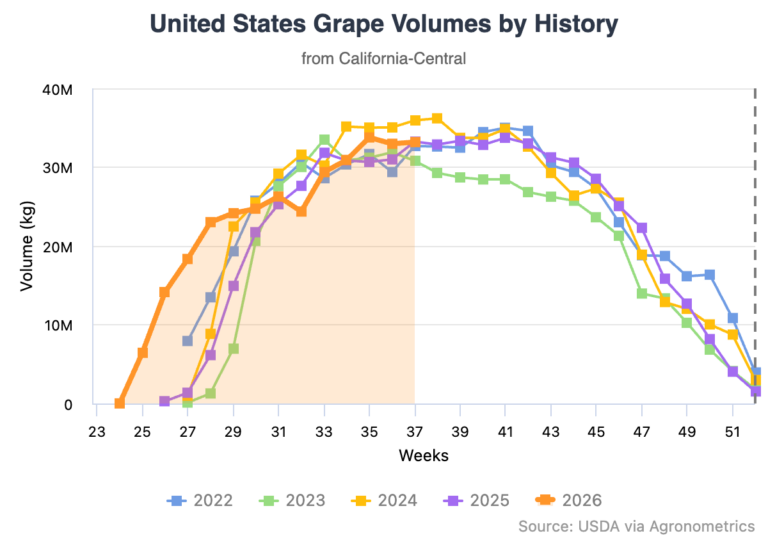
California’s 2026 table grape season was shaped by an exceptionally warm winter and spring.
NOAA ranked 2025/26 as the warmest winter on record for its West and Southwest climate regions, followed by California’s warmest and driest March on record.
Vines responded quickly. Grower Pete Hronis described the bloom as the earliest he had seen in more than 40 years, while the California Table Grape Commission (CTGC) projected Coachella Valley production to begin in early May and the San Joaquin Valley in mid-June, roughly two to three weeks ahead of normal.
That lead has persisted. CJ Buxman of Sunny Cal Farms said the crop remained about three weeks ahead through the season, while John Pandol of Pandol Bros. put shipping roughly two to two and a half weeks ahead of normal. Harvest and shipping are also expected to finish early.
An early crop, however, has not meant a smaller crop overall. Buxman said volume has generally tracked expectations, although July heat affected some delicate and heirloom varieties.
Source: USDA Market News via Agronometrics.
The fall squeeze
The bigger issue is now the length of the season. Most shippers aim to carry fruit through Thanksgiving, but a crop that started two to three weeks early has less time to reach that point. Buxman expects supplies to tighten through the fall, with greens tightening earlier and more sharply than reds, just as consumer demand typically increases after summer.
September is particularly important: Pandol estimates US grape purchases are about 50 percent higher than in July or December. His strategy is to sell through the California crop before buyers shift to imports, and Pandol Bros. has already warned customers that availability will differ this season.
Late-season programs are centered on varieties including Autumn King, Allison, Autumn Royal, Sweet Globe, Sweet Celebration, and Scarlet Royal. Shippers report strong Brix, large berries and good crunch, although volume is affected by the accelerated harvest.
An earlier opening for imports
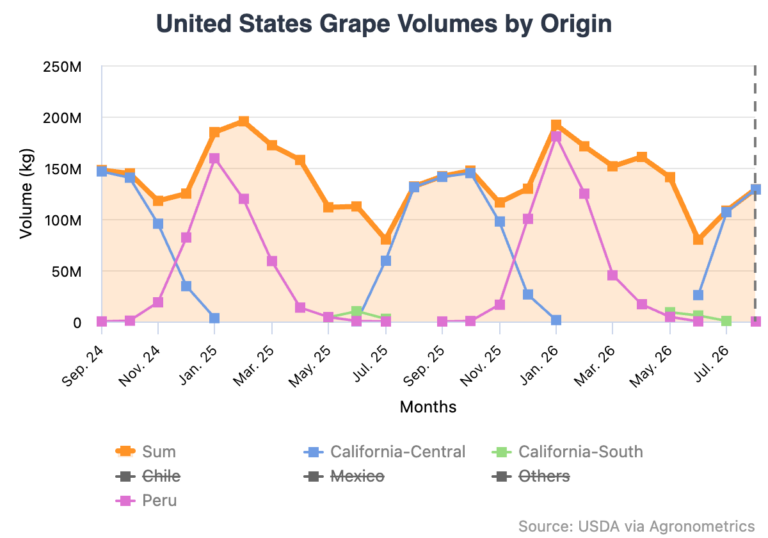
The calendar is creating an unusually early import handover. Justin Bedwell of Bari Produce expects imports to open sooner than in previous seasons, making October and November particularly important for retailers seeking uninterrupted supply.
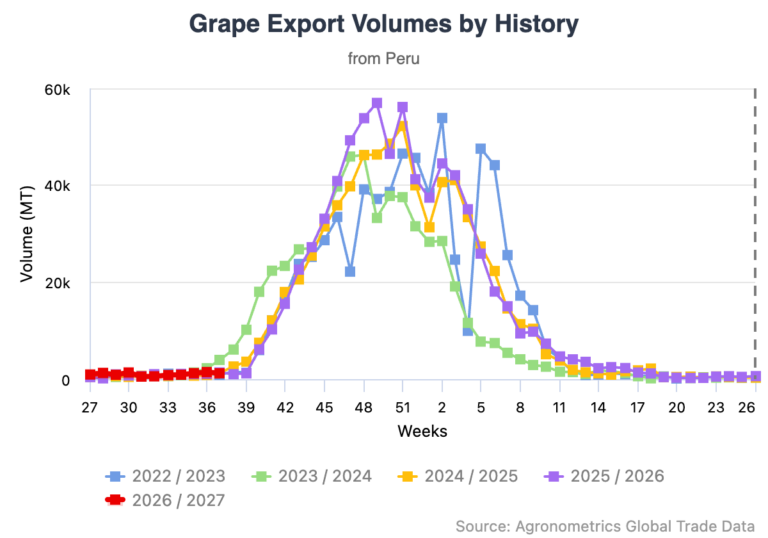
Peru is also running ahead of schedule. The Peruvian Table Grape Producers Association (PROVID) estimates harvest in its main regions will be seven to 15 days early, with exports historically concentrated from the first week of October through week 13.
The complication is volume. PROVID projects 82.6 million 18.1-lb boxes for 2026/27, about five percent below the previous season, citing El Niño-related productivity impacts. The US remains Peru’s largest market, accounting for 52 percent of shipments in 2025/26.
The timing therefore points in the same direction: California is likely to finish early, while Peru is likely to arrive early as well. Whether that creates a smooth transition or a supply gap will depend on how long California’s late varieties hold and how quickly Peru builds volume.
Source: USDA Market News via Agronometrics.
Source: USDA Market News via Agronometrics.
A smaller production base
The accelerated season is also occurring against a shrinking California production footprint. USDA NASS reported 118,000 acres of table grapes in 2025, down from 120,000 in 2024 and 125,000 in 2023. Bearing acreage remained at 115,000, while non-bearing acreage fell from 5,000 to 3,000 acres.
Flame Seedless remains the largest variety at roughly 10,500 acres, followed by Autumn King at 6,300, and Scarlet Royal at 6,000. Among non-bearing plantings, Autumn Crisp leads with 448 acres.
Growers are using tools such as plastic vine covers and storage totes to extend the late-season window, although these measures can add cost.
What to watch
The 2026 season has delivered strong volume and quality despite its unusually early start. The main question now is the back end.
Key indicators through October and November will be California’s late-variety shipments, particularly greens; the timing and volume of Peruvian arrivals; and pricing during the transition between the two origins.
With California finishing early and Peru projecting a smaller crop, the handover could become one of the season’s most important market windows.
*Main photo is referential via Shutterstock | Graphs courtesy of Agronometrics
Related stories
California grapes fall short of 100-million box target after rainy finish