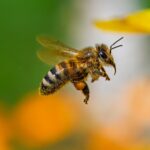



New study reveals color coding can save stingless bee colonies

 Add Fresh Fruit Portal to Google
A simple splash of color could help stingless bees find their way home, supporting pollination for a wide range of crops. Researchers from the Brazilian Agricultural Research Corporation (Embrapa) and the University of Bristol in the United Kingdom are evaluating simple, low-cost strategies to reduce navigation errors among stingless bees.
The phenomenon, known as drifting, occurs when worker bees return from the field and mistakenly enter a colony that is not their own. Frequent drifting can spread pathogens, parasites, and crop protection chemical residues, threatening hive health and honey production.

Led by Ana Paula Cipriano, a doctoral candidate at the University of Bristol and member of the Bristol Bee Group, the study evaluated two Brazilian stingless bee species: Scaptotrigona depilis and Melipona quadrifasciata, both vital for pollinating agricultural crops and native tropical vegetation.
A pop of color to lead the way
When researchers placed identical hive boxes with entrances facing the same direction, nearly 60 5 percent of returning bees entered the wrong colony. Alternating entrance directions reduced drifting to 48 percent, while using different-colored boxes with entrances facing the same direction reduced the rate to nearly 38 percent.
The findings indicate that bees use visual and spatial cues to locate their colonies, rather than relying solely on distance.
"This is the first time we have analyzed the effect of layout on drifting behavior. Simply painting the boxes or reversing entrance orientations produced a significant drop in navigation errors," explained Cristiano Menezes, a researcher at Embrapa.
Menezes said the approaches could be particularly useful in meliponaries (specialized apiaries for stingless bees) with high nest density and limited space.

The study also uses radio-frequency identification (RFID) micro-tags to monitor individual bees. The tags, manufactured in Germany, are attached to bees' backs with an odorless adhesive and represent about 11 percent of a bee's body weight.
The sensors record departure and return times, flight duration, visits to neighboring colonies, and periods of peak activity. Researchers can compare the data with environmental conditions, including temperature and humidity.
"The technology acts like a spy monitoring every movement, uncovering behavioral details that were previously invisible," Cipriano said.
Pesticides can affect bee flight patterns
Researchers also assessed the effects of the insecticide imidacloprid and the widely used agricultural herbicide, glyphosate.
Preliminary, unpublished findings indicate that pesticide exposure changes worker bees’ flight patterns. The insects continued to return to their nests but made fewer trips and remained active for shorter periods.
"With pesticides, they continue making errors, but they make fewer trips. Combining the insecticide with glyphosate resulted in flights that were at least 34 percent shorter," Cipriano noted.
Reduced flight frequency and duration could also affect food availability within colonies.
"Glyphosate can impair spatial orientation. When a bee loses its landmarks, the chance of entering a neighboring colony increases, potentially spreading pathogens and compromising colony balance," he explained.
The next phase will involve recapturing monitored bees to assess body weight, pollen loads, nectar quality, and potential effects on colony nutrition.
* Main image by Cherre Da Silva | Copyright Creative Commons.
Related stories
Colorado bill set to protect state-grown produce
Citrus falls in love again: ONIX brims with color, discovery, and shelf impact
India's horticultural agency working to release new colorful mangos