Small insect with big potential: UGA researchers put black soldier flies to work

 Add Fresh Fruit Portal to Google
Oftentimes, researchers will tell you they are looking for a silver bullet. A single solution to a highly complex problem.
For vegetable entomologist Saumik Basu, the search for that elusive solution has led to an unlikely insect that could come surprisingly close.
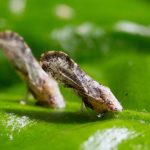
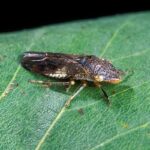
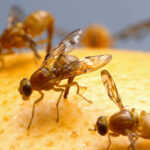
Despite their intimidating name, black soldier flies aren’t aggressive. These gentle, beneficial insects don’t swarm, bite, or sting, and they don’t damage crops. While their name comes from the adult fly’s upright posture and dark appearance, it is their voracious larvae that have gained the attention of researchers and agriculturalists.

Image courtesy of the University of Georgia
Black soldier fly (Hermetia illucens) larvae are remarkably efficient decomposers, capable of turning a wide range of organic materials, including food scraps and animal waste, into valuable agricultural inputs. And they work fast. In just two weeks, about one pound of newly hatched larvae can devour more than 16 tons of waste, converting it into roughly one ton of protein- and nutrient-rich compost.
The larvae themselves are also rich in protein and fatty acids and can potentially be used as an ingredient in animal, poultry, and aquaculture feed.
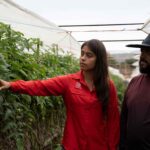
At the University of Georgia’s Tifton campus, Basu and postdoctoral researcher Abdul Jalloh are exploring how those established benefits could be harnessed to support more sustainable agricultural systems. Their research asks whether black soldier flies could help address several challenges at once, from recycling agricultural waste and improving soil health to producing alternative animal feed and helping crops better withstand pests and diseases.
Black soldier flies: Beyond killing pests
For Basu, that myriad potential fits naturally into integrated pest management, or IPM, an approach that combines multiple strategies to manage pests while reducing reliance on conventional pesticides.
An assistant professor in the UGA Department of Entomology, Basu leads a vegetable entomology and IPM program studying pests affecting crops including peppers, tomatoes, and cabbage. But sustainable pest management, he said, requires looking beyond how to kill the insect attacking a crop.
“When people think about pest management, they often only focus on killing the problematic pest,” Basu said.

Image via Shutterstock
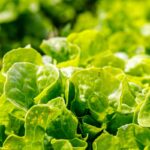
That broader approach led Basu and Jalloh to investigate another benefit of black soldier fly larvae. Their excrement (called frass) is a nutrient-rich soil amendment that has long been studied for its potential to improve soil and plant health.
Their research examines how amending soil with frass influences plant growth and helps them withstand damage from insect pests and plant pathogens.
“It has remarkable immune-boosting properties,” Basu said. “We are investigating whether it can improve soil and plant health while stimulating natural plant defense responses against pathogens and feeding damage caused by insect pests.”
One insect, many research collaborations
The researchers are maintaining two black soldier fly colonies at UGA-Tifton, and the work is already creating a much larger research network. Basu and Jalloh have connected with researchers across crop and soil sciences, plant pathology, animal science, food science, engineering, and microbiology to explore how black soldier flies could be used throughout agricultural systems.
Together, they are pursuing external funding for research spanning Georgia’s vegetable and blueberry industries, poultry and other animal production systems, soil health, and food-waste management.
A more circular agricultural system
The breadth of the project positions it within a One Health framework, which recognizes that plant, animal, human, and environmental health are interconnected.
“Black soldier flies offer an unusual opportunity to study those connections through a single biological system,” Basu said.

Image via Shutterstock
“Instead of viewing these components separately, we can investigate how they can work together to create more sustainable and circular agricultural systems,” Jalloh added.
Each step creates another opportunity down the line, turning what was once waste into a valuable resource.
“Black soldier flies give us an opportunity to rethink the relationship between waste, insects, soil, plants and animals,” Jalloh added.
For Basu, bringing those connections together is central to the long-term research vision.
This story was written by Emily Cabrera and was originally published on the University of Georgia website.
Related stories
The one gene behind the millions-of-years-old mechanism ruling avocados’ sex-changing flowers