



Indonesia: a new era for Chilean cherry exports
 Add Fresh Fruit Portal to Google
The world's largest producer and exporter of cherries, Chile is navigating the challenge of diversifying its shipments amid growing yields.
And it’s doing a good job, too. This season, the Andean country reached a new milestone by sending its first batch of fresh cherries via air freight to Indonesia. Although the fruit has reached the archipelago by sea for years, this logistical alternative opens new opportunities for an industry looking to expand its international footprint.
Patricio Riveros, Chile's agricultural attaché in Indonesia, told FreshFruitPortal.com that this first batch was of the Santina variety, whose "initial reception has been positive, especially in aspects such as firmness, sweetness, and arrival conditions of the fruit."
A market with potential yet to be discovered
With a population of nearly 290 million, Indonesia offers an attractive opportunity for the Chilean industry, as about 10 percent of the country’s population could have access to this high-value international fruit valued at $6 million in 2025.
Rather than depending on spot market transactions, Riveros said that the Indonesian fresh fruit import market operates through supermarkets and e-commerce channels. Through there, the market processes large volumes of cherries from Australia, as well as smaller batches from New Zealand and Türkiye.

Vía Instagram Hobibuah.
These origins have driven growth in the Indonesian cherry market, which has expanded at a 12 percent CAGR over the last five years, with a 2024/2025 year-on-year variation of 21 percent. And this, Riveros said, is only the start.
"Given the country’s demographic composition, its economic dynamism, and as-yet unexplored cities, along with the presence of a large Chinese diaspora, the consumption ceiling is still unknown,” he stressed.
There’s still work to be done
According to Riveros, the organoleptic characteristics sought by Indonesian consumers align with the strengths of Chilean fruit: firmness, sweetness, ease of separating the flesh from the pit, and an attractive red color. Additionally, varieties with more yellowish tones could also find commercial space, something Chile’s main trade partner in the region, China, doesn’t offer.
The prospects are positive, but there’s still a lot to do in this market. According to Riverosn, Chile needs a solid positioning strategy to differentiate its fruit from competitors. In that regard, the Latin American country has its work cut out for it, as other origins in Indonesia have developed the market for decades.
“Australia, New Zealand, the United States, and Canada are examples of countries that have worked consistently on identifying their products through origin distinctions, messages associated with quality, and attributes linked to their territories,” he explained.
For example, local supermarkets feature advertisements highlighting product origin and using slogans related to reliability and production-quality attributes.
The agricultural attaché said that Chile’s strategy must be multi-layered. For starters, he said the industry should speak to importers and supermarkets to promote the attributes and production techniques associated with Chilean fruit.
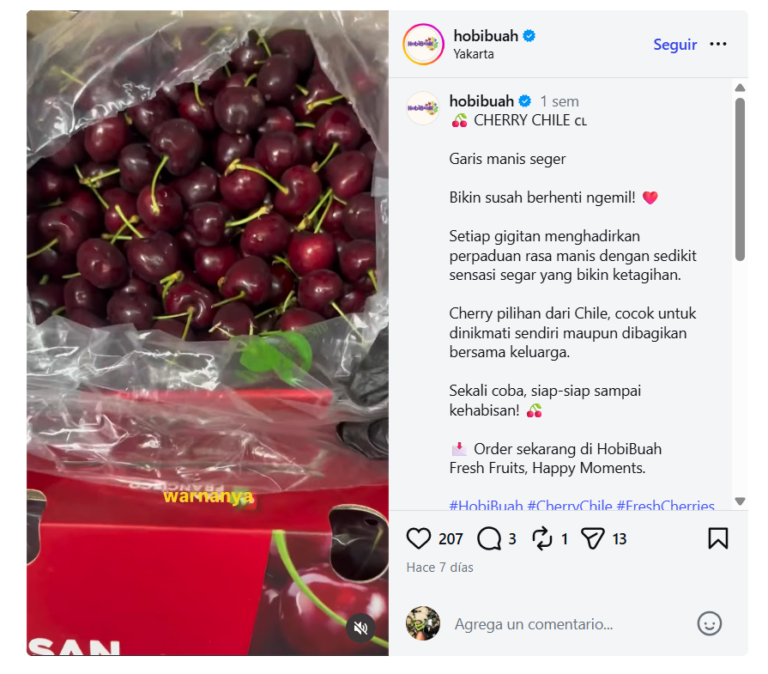
Vía Instagram Hobibuah.
To consumers, the sector should emphasize cherries’ nutritional properties and benefits. The best way to do it? Social media, whose penetration in the Asian country is particularly high.
“Platforms like Instagram, TikTok, Facebook, and Snapchat represent relevant channels to reach segments of young professionals who value trends and products that acquire digital visibility,” he said.
The coup de grace for a successful campaign is a strong Chile brand that, beyond cherries, promotes the country’s myriad attributes, including tourism, natural resources, and the quality of its agri-food products.
Cherries: a gift with commercial opportunity
Chilean cherries have found success in China, as the fruit there is bought as a gift, especially for the Lunar New Year. Fortunately for Latin American producers and exporters, this trend is also present in Indonesia, where high-end imported fruit plays an important role in special occasions.
For this first air freight shipment, Riveros said Chilean cherries sold for approximately $49 per kilo. Meanwhile, 2.5-kilo boxes were sold for over $110.
The diplomat stressed that there’s still room to grow and that importers have shown interest in developing the category through promotional actions. The challenge for the Chilean industry, he added, is to seize the moment before other competitors further strengthen their market position.
"Indonesia is today. We must seize the moment," he concluded.
*Images courtesy of Patricio Riveros.
Related stories
First chartered Chilean cherry shipment lands in China to soft prices