Brazil oranges hit hard by high fruit drop rates and lower production, Fundecitrus warns
 Add Fresh Fruit Portal to Google
Fendecitrus, the Defense Fund for Citrus Plant, released the first re-estimation of the 2025/26 Brazil orange production for the citrus belt of São Paulo and the Triângulo/Southwest of Minas region.
The association representing citrus growers and the juice industry in the state of São Paulo reported that they expect a production of 306.74 million 90-pound orange boxes. This represents a 2.5 percent drop compared to Fundecitrus’ May estimate of 314.60 million boxes. The new projection is the direct result of more severe greening disease and a slower harvest pace, which has increased the projected fruit drop rate.
A slow 2025 harvest for Brazil oranges
Fundecitrus detailed that, as of mid-August, only 25 percent of the current harvest had been collected, a significantly slower pace than in the previous season, when around 50 percent of production was off the tree by that time.
The harvest of Hamlin, Westin, and Rubi reached 68 percent, while that of other early varieties reached 75 percent. The Pera harvest reached 17 percent. When it comes to late varieties, the harvest of Valencia and Folha Murcha totals one percent, and Natal is reaching two percent.
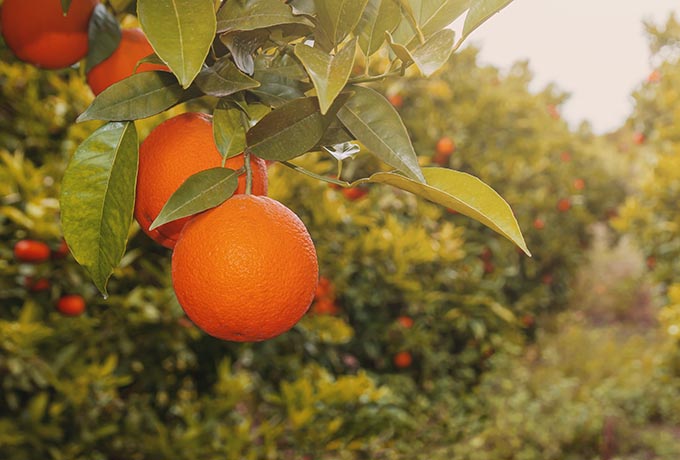
The delayed harvest timeline this season may be attributed to a higher concentration of fruit from the second flowering, as well as the prioritization of harvesting at an optimal ripening point to obtain high-quality juice. This has led to an increase in the rate of premature fruit drop, especially in trees affected by greening disease, water deficit, and milder winter temperatures.
Higher fruit drop and greening disease severity
Initially projected at 20 percent in May, the fruit drop rate was re-estimated at 22 percent. This figure has been higher in areas more prone to greening disease (South, Center, and Southwest) and lower in sectors where the spread of the fungus is slower (North and Northwest).
The executive director of Fundecitrus, Juliano Ayres, noted that the institution's annual survey reported an increase in the average severity of greening disease in the citrus belt from 19 percent in 2024 to 22.7 percent in 2025. This has resulted in the reduction of approximately 35 percent of the region’s productive potential.
"This significant increase in the severity of symptoms in trees directly triggers a higher rate of premature fruit drop. This is the determining factor for the reduction of the harvest in this first re-estimation," said Ayres.
Brazil oranges in numbers
The rainy weather in April and June ensured a good level of soil moisture, which enabled fruit weight in early varieties such as Hamlin, Westin, and Rubi to remain at 1.43 ounces (305 pieces per box). Other early varieties (Valencia Americana, Seleta, Pineapple, and Alvorada) experienced a decrease in size, from 5.6 ounces (259 fruits per box) to 5.3 ounces (272 fruits per box).
Meanwhile, the Pera variety, whose harvest is later this year, should benefit from spring rains, increasing its weight from 5.4 ounces (265 fruits per box) to 5.5 ounces (261 fruits per box).
Valencia and Folha Murcha varieties are estimated to maintain 6.1 ounces (235 fruits per box), and while Natal should maintain its weight to 6 ounces (242 fruits per box). In general, the projected average orange size remains unchanged.
Related stories
Brazil's 2024/25 orange harvest one of the worst in 37 years
Quality of Brazil oranges has dropped this year
Brazil: Fundecitrus projects a 36% YoY orange crop increase for 2025/26