








Agronometrics in Charts: Record July heat leaves Piura mango flowering near 10 percent



Each week, the series ‘Agronometrics In Charts’ examines a different horticultural commodity, focusing on a specific origin or topic and visualizing the trade market factors driving change. Check out our entire archive.


Hopes of a rebound in Peru's 2026/27 mango crop are fading after an unprecedented run of winter warmth in the country's main growing region.
Agricultural specialist Milton Calle told Agraria that flowering across Piura stood at roughly 10 percent at the start of August, with little scope for improvement.
"It is highly unlikely that we will reach 15 percent," he said, citing July temperatures never previously registered for that point in the calendar.
Mango trees need sustained cold accumulation to trigger flower induction. Without it, they carry vegetative growth into spring instead of setting flowers.
Calle cautioned against interpreting a 10 percent flowering rate as a 90 percent collapse in export volume, arguing that calculations must account for Peru’s total planted area.
Unofficially, he estimates the actual footprint at nearly 135,900 acres once unregistered plantings are included—substantially higher than the roughly 76,600 acres officially recorded for Piura, which alone represents about 65 percent of national production.
On that basis, a 10 percent flowering rate corresponds to 13,590 productive acres and, at a yield of roughly 6.24 tons per acre, output would still reach approximately 84,875 tons.
Larger mangos to constrain retail programs
Size is the second constraint. Light flowering means fewer fruit per tree and therefore larger fruit: Calle expects counts 4, 5, and 6 to dominate, with 10s and 12s effectively disappearing. Since European and US retail programs are built around smaller counts, that reduces the genuinely exportable share of whatever is harvested.
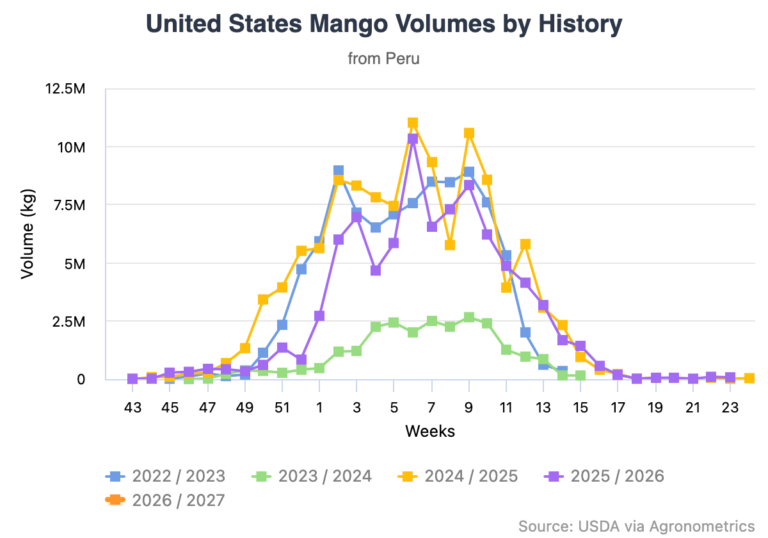
Peru harvested approximately 245,800 tons in 2025/26, down 22 percent from the previous cycle's 315,250 tons and eight percent short of forecast, according to Apem president Keyner Gamarra, who attributed the shortfall to adverse weather compounded by trees still recovering from a record year.
Warm nights blunted induction, a cold snap in early December caused fruit drop, and January–February rain hit quality in Motupe and Casma. The United States took nearly 92,800 tons, or 38 percent of shipments, with Europe absorbing approximately 123,870 tons.
Source: USDA Market News via Agronometrics.
*All photos are referential via Unsplash | Graphs courtesy of Agronometrics
Related stories
Costa Rica boosts the competitiveness of its mango industry with a quality-based strategy
Jalisco launches ambitious plan to enhance mango health and reduce fruit fly populations





Subscribe to our newsletter