


Opinion | Yes, it rained in California. Here’s why that doesn’t matter.
 Add Fresh Fruit Portal to Google
By John Pandol
John is Director of Special Projects at California-based Pandol Brothers, and has been deeply involved in the agricultural business for over 40 years. His family is a long-time grower and seller of table grapes in the Golden State.
Produce has inherent volatility. On the production side, volume, timing, quality, and condition are ever-changing pieces in a complex puzzle, determined by forces often beyond our control. A storm on the other side of the world or even a couple of unexpected inches of rain can wreak havoc on an otherwise great season.
It’s easy to blame Mother Nature when things get rough, but we usually forget that it’s not just the forces beyond that determine outcomes in our industry.
The human factor is often overlooked in the list of causes of volatility. Producers, distributors, and retailers held hundreds of meetings in Anaheim, California, a couple of weeks ago. Discussions focused on supply availability and sales strategies for Southern Hemisphere grape programs, with delivery dates ranging from six weeks to six months in the future.
Almost universal in these discussions is a desire to reduce risk by doing only programs, as these offer known volumes, specifications, delivery dates, and prices. Their convenience is why programs account for around 60 percent of US retail, but that leaves little interest for planning for the remaining 40 percent of the market that buys closer to the date.

These coveted programs have gravitated toward those growers and exporters who have demonstrated good performance, business compliance, and a reliable ability to forecast future supply. Suppliers with lower performance histories, either due to less reliable forecasting or more opportunistic business practices, are not often favored by distributors and retailers.
However, programs are not a perfect solution to volatility, as they can be tainted by human decisions. When a market condition, such as price or volume, suddenly changes from what it was before the program was created, those sellers who wanted security may become opportunistic or even speculative. Pricing and volume allocation are 100% human decisions. Covering a program then becomes a hostage negotiation, and generating new business becomes a bidding war.
There was a situation last January when the supply of table grapes was high but availability was low, driving prices up. This resulted from sellers with lots of fruit who knew more was on the way and refused to sell for high prices. In soccer, that’s called an own goal. It took months for the market to go back to balance.
Then, in June, a rain in Mexico caused sellers to freeze in place. The change in weather led to a serious underestimation of future supplies, resulting in cherries dominating supermarket shelves for two months. This not only impacted desert grapes, which were on their way out, but the effects were felt at least a month into the Central California season.
Again, these were not examples of unforeseeable and totally unexpected acts of God, but rather very real, controllable human decisions.
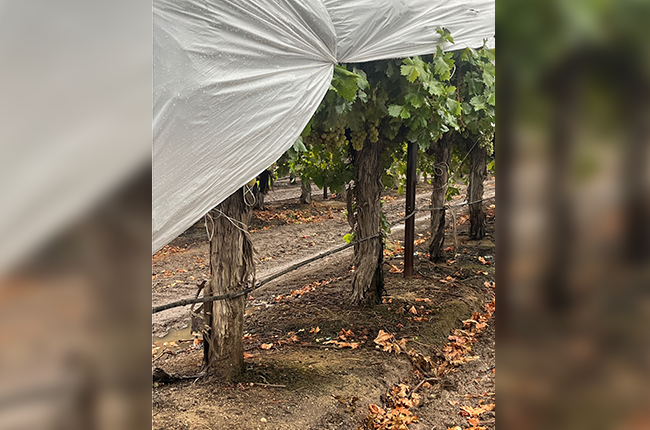
So, it rained about an inch in California recently. Is it actually relevant?
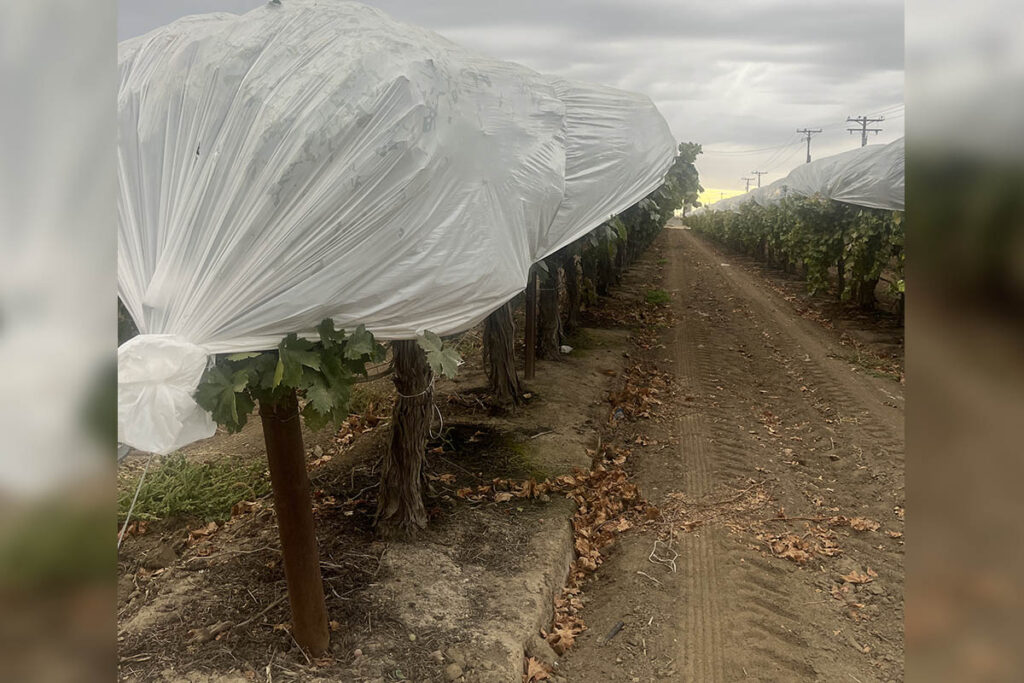
Retailers are currently evaluating their California grape strategies and their transition dates to Southern Hemisphere supplies. On the day it rained, there were over 10 million boxes of fruit in cold storage, and another 25 to 30 million still to be harvested. There were also at least 20,000 acres covered with plastic, which is the usual practice for November and December harvests, but not as normal in October.
So—volume forecast. Does this mean the loss of the five to ten percent of grapes left to harvest? Or maybe an earlier transition into the Southern Hemisphere supply?
The answer is perhaps, and no.
I want to call out two myths.
1.- California finishes harvesting in late October. False. Over 40 years of hard and anecdotal data show that the end of the grape harvest usually happens after Thanksgiving, at the end of November.
2.- When it rains on a vineyard, all future harvest is lost. Also false. Never true. Fake news. It’s only an inch of rain, not a flood of Biblical proportions.
Theoretically, if the remaining California grapes are sold at the same rate, transitions would take place a week or 10 days earlier. This is all to say that, if the California Table Grape season experiences any changes greater than this, it won’t be because of the volatility inherent to the fresh produce sector, but rather the result of human decisions.
Business does not operate in a vacuum. Past experience shows that grape sales slow down a little, and supply will stretch a bit. So, transition dates should remain unchanged. Besides, December is a big vegetable month. Fruit is less relevant.
* Images courtesy of John Pandol
Related stories
Q&A: John Pandol on Californian grape season, import saturation and tariffs