


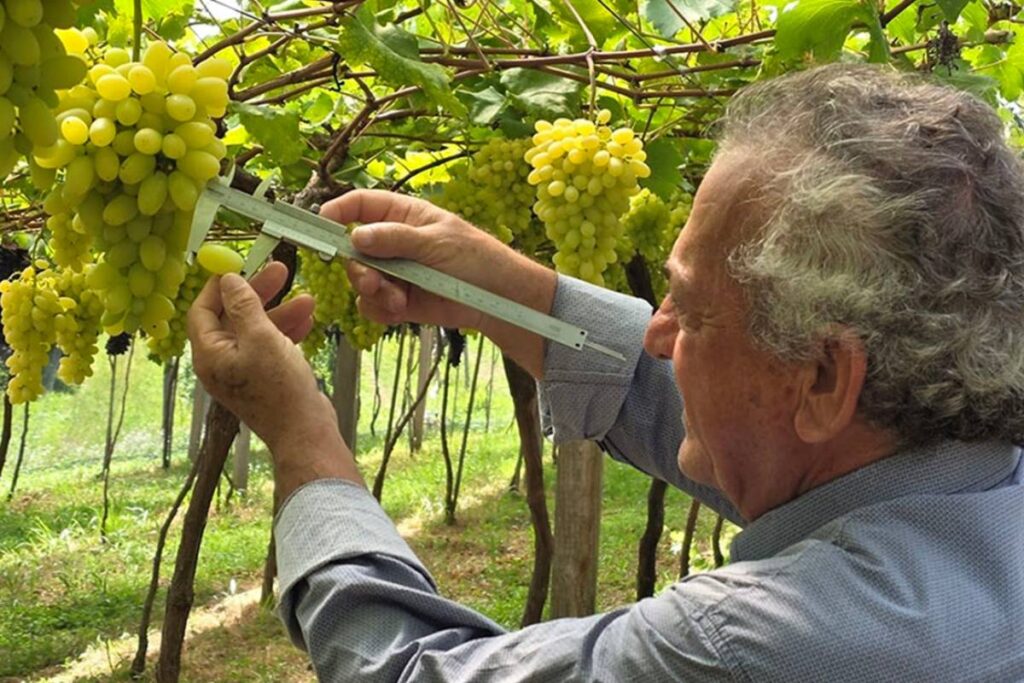


In southern Brazil, the Empresa Brasileira de Pesquisa Agropecuária (Embrapa) presented BRS Pérola, a new white seedless table grape variety that combines high productivity with ease of management.
Trials conducted in the Serra Gaúcha and Santa Catarina show a productive potential of up to 12 tons per acre under plastic cover, a key system for protected cultivation in the area.
The new cultivar expands the offering of grapes for fresh consumption in the south of the country, joining the portfolio developed by the Uvas do Brasil program, which already includes varieties such as BRS Vitória, BRS Isis, and BRS Melodia.
As explained by João Maia, a researcher at Embrapa Uva e Vinho, there is a relevant space in the region for the production of table grapes for sale on both farms and in small establishments. Additionally, there’s a growing demand for a white seedless variety that can partially replace the now-traditional Italia.
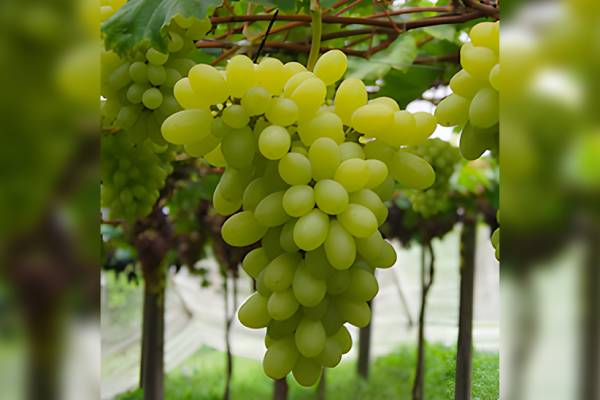
Photo Patrícia Ritschel
"The increase in rural tourism and wine tourism has driven investments in table grapes for direct sale under the 'pick and pay' system, which allows for expanding margins through direct contact with the consumer," said Maia.
The berries of BRS Pérola are similar to those of Thompson Seedless, a reference in the white seedless grape market in Brazil. The new cultivar stands out for its elongated berry, bright yellow color, and crunchy and firm texture. It also features a neutral flavor balanced between sugars and acidity.
Patrícia Ritschel, one of the coordinators of the Uvas do Brasil program, highlighted that one of the main attributes of BRS Pérola is its low bunch compactness, which facilitates thinning and reduces labor demand.
"The plants show good bud fertility on medium canes, allowing productivity between 10 and 12 tons per acre with mixed pruning," she indicated.
In the Serra Gaúcha, after the application of gibberellic acid, the berries reach about ¾ inch in diameter, with colorless pulp and a moderately firm texture.
The production cycle, under plastic cover, is approximately 170 days from bud break to harvest, which takes place in February, positioning it as a medium-cycle variety in the region.
The grape grower Jair Freiberger, one of the validators of BRS Pérola in the municipality of Alto Feliz (RS), emphasized BRS Pérola’s commercial potential. In his third year of production, he says the variety combines three distinctive attributes: a longer berry, attractive coloration, and crunchiness.
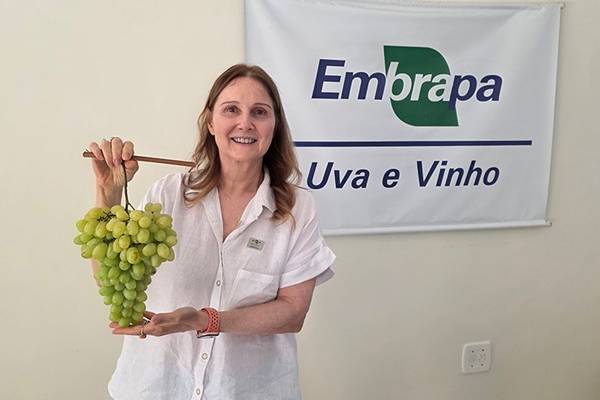
Patrícia Ritschel | Photo by Viviane Zanella.
On his nearly 2.5-acre farm, operated under the "pick and pay" system, he projects that young consumers will opt for this new alternative over the traditional Italia due to its seedlessness.
For Adeliano Cargnin, general manager of Embrapa Uva e Vinho, BRS Pérola can add value to the production of the Serra Gaúcha, strengthen table viticulture, and consolidate the role of public science in the sustainable development of Brazilian agriculture.
BRS Pérola is recommended for the Serra Gaúcha in a trellis system, with spacing of eight feet between rows and 6.5 feet between plants, grafted onto Paulsen 1103 rootstock, and with mandatory use of plastic cover to ensure quality in table grapes. Its cultivation is not recommended in the Brazilian Semi-arid region.
Initial commercialization will be handled by the licensed nurseries Viecelli Viveiros (Videira - SC) and MP Mudas (Vacaria - RS), which are already accepting orders for plant production in 2026.
Other licensed nursery operators may acquire basic material by reserving it at the Canoinhas Experimental Station (SC), between April and June, with deliveries scheduled between the second half of July and mid-August.
*All images courtesy of Embrapa.
Related stories
Grape expectations: Global table grape trade reshapes supply and demand