Agronometrics in Charts: Diesel costs rise up to 49 percent for produce transport
 Add Fresh Fruit Portal to Google
Each week, the series ‘Agronometrics In Charts’ looks at a different horticultural commodity, focusing on a specific origin or topic, and visualizing trade market factors that are driving change. Check out our entire archive.
The fresh produce industry is once again being tested by forces far beyond the farm. What began as a geopolitical crisis is now cascading through energy markets, logistics networks, and ultimately, the economics of growing food. Insights from the International Fresh Produce Association (IFPA) and recent freight market data point to a supply chain under mounting strain, one where cost pressures are rising faster than the system can absorb.
At the center of the disruption is energy. Fuel prices have surged sharply across regions, with diesel costs rising by 11 to 49 percent, depending on the market. For an industry built on speed and temperature control, these increases are not just incremental—they are structural. Cold chain logistics, from refrigerated trucks to ocean containers, depend heavily on fuel stability. As surcharges are added across ocean, air, and land transport, the cost of simply moving fresh produce is climbing in real time.
Freight markets are already reflecting this shift. Following disruptions in key shipping routes, including constrained movement through the Strait of Hormuz, container rates have rebounded despite relatively soft demand.
Rates from Asia to the US West Coast have jumped nearly 40 percent since late February, while Asia to Northern Europe routes are up around 20 percent. Airfreight tells a similar story, with rates from South Asia to Europe rising more than 60 percent, as capacity remains constrained and fuel availability tightens.
Logistics and input prices are weighing on the produce sector
But while logistics costs are rising quickly, production-side pressures may prove even more consequential. Fertilizer prices, particularly urea, have surged, adding over $260 per ton in just a few months.
This comes on top of an already elevated cost base, with fertilizer prices projected to be significantly higher than historical norms. Unlike fuel, which impacts daily operations, fertilizer costs shape decisions months in advance. They influence what gets planted, how much is invested, and ultimately how much supply reaches the market.
This is where the pressure becomes systemic. Growers are facing rising input costs without corresponding increases in returns. In fact, many key crops have seen declines in farmgate prices in recent years: honeydew melons down 35 percent, bell peppers down 29 percent, and cabbage down 11 percent. The result is a widening gap between costs and revenues, one that is increasingly difficult to sustain.
The risk is not an immediate shortage, but a delayed consequence. If growers respond rationally by reducing plantings, cutting inputs, or exiting certain crops, the effects will surface later as tighter supply, reduced variety, and higher consumer prices.
In this sense, today's cost shock is planting the seeds of tomorrow's market imbalance.

What makes the current moment particularly complex is its uneven geography. Regions closer to the conflict are experiencing more acute disruptions, especially in fuel supply and logistics capacity. Yet global commodity pricing ensures that no market is insulated. Fuel constraints in one region ripple across trade lanes, while shipping delays and rerouting affect global availability and pricing structures.
There are early signs of adjustment. Freight markets are resisting sharper increases due to underlying demand softness, with some carriers offering discounts below announced rates. However, structural risks remain.
For the fresh produce sector, the challenge is not just absorbing higher costs, but maintaining confidence across the supply chain. As IFPA emphasizes, the decisions made now by retailers, buyers, and policymakers will determine whether growers continue to invest in production or begin to scale back. Because ultimately, this is not just a logistics story or an input cost story: It is a supply story in the making.
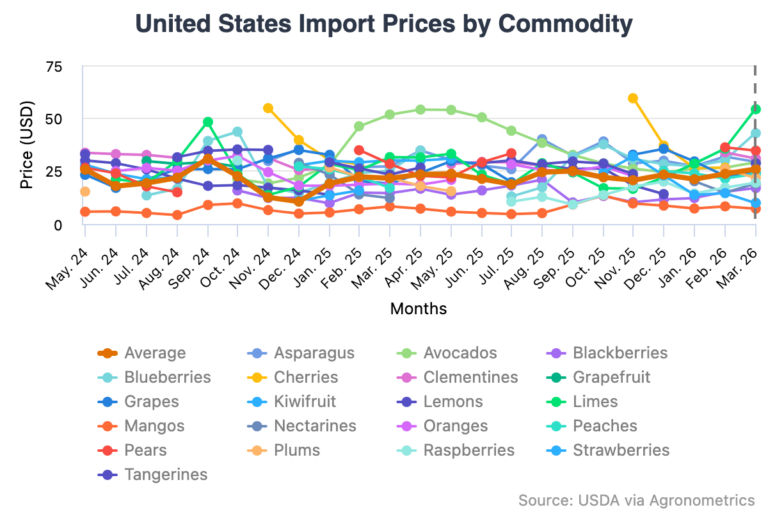
Source: USDA Market News via Agronometrics. (Agronometrics users can view this chart with live updates here)
Related articles:
Opinion | Geopolitics reshapes the budget: How war is now a core variable in fresh fruit logistics