


Agronometrics in Charts: Global produce trade faces growing pressure from Middle East conflict

 Add Fresh Fruit Portal to Google
Each week, the series ‘Agronometrics In Charts’ examines a different horticultural commodity, focusing on a specific origin or topic and visualizing the trade market factors driving change. Check out our entire archive.
Geopolitical tensions in the Middle East, particularly between the United States and Iran, are continuing to create uncertainty across global logistics and fresh produce markets. Rising fuel prices, war risk surcharges, and shipping delays are increasing pressure on importers, exporters, and growers already dealing with unstable trade conditions.
According to logistics company Shypple, freight markets remain volatile as vessels continue rerouting around the Cape of Good Hope instead of using the Red Sea and Suez Canal. While some Asia-Europe freight rates have started to decline as carriers try to fill vessels, shipping costs from India and the Middle East continue to rise.
The company said increasing Bunker Adjustment Factors and War Risk Surcharges are adding further costs to global supply chains, making it harder for businesses to plan ahead.
Shypple procurement analyst Dennis Wietsma told news outlet HaulProduce.com that importers are now being forced to choose between the stability of long-term contracts and the unpredictability of spot market pricing.
“Do you opt for the security of a long-term contract, knowing you will still pay emergency surcharges on top of it? Or do you dare to ride the volatile spot market, where rates might drop, but you pay top dollar the moment a new geopolitical escalation occurs?” the executive said.
Middle East logistics strain
The fresh produce industry is especially vulnerable because fruits and vegetables rely on fast and consistent transportation. Industry leaders have described the current trade environment as “uncertainty,” “volatility,” and “complex,” with rising logistics costs creating additional strain throughout the supply chain.
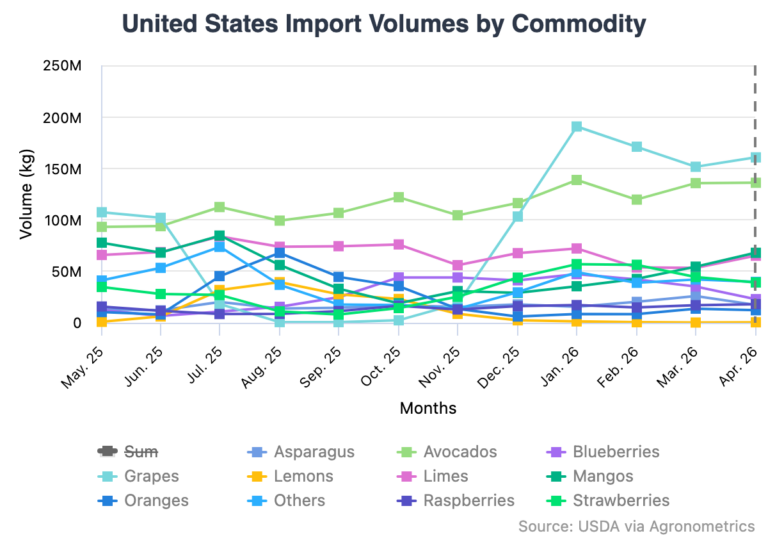
Source: USDA Market News via Agronometrics.
Anthony Serafino, President of Exp Group, told The Packer that geopolitical instability has become one of the biggest challenges facing produce businesses today.
“Geopolitical issues are the biggest headwind you can face in running a business. A lot of things are out of your control,” Serafino said.
He added that rising fuel costs have forced his company to change how it manages freight expenses.
“For the first time in our company’s history, we’re adjusting logistics costs weekly. Not monthly, not quarterly—weekly,” he emphasized.
Shypple also noted that unreliable ETA data is becoming an increasingly serious operational issue. Many carriers are still calculating transit times using outdated Suez Canal routes, causing delays to appear later in the shipping process. The company said independent shipment tracking is becoming increasingly important for supply chain visibility.
For many non-food importers, the solution has been to build larger inventory buffers. Fresh produce companies, however, have far fewer options because products are highly perishable. As a result, refrigerated cargo sectors such as fruits, vegetables, and plants are relying more heavily on stable shipping routes and fixed allocations from Central and South America.
Industry groups warn that continued instability could have lasting effects on growers and exporters. US Apple Association President and CEO Jim Bair told The Packer that unstable export markets quickly create pressure on domestic prices and grower margins.
With freight costs rising and global trade tensions continuing, many in the produce industry are bracing for continued uncertainty in the months ahead.
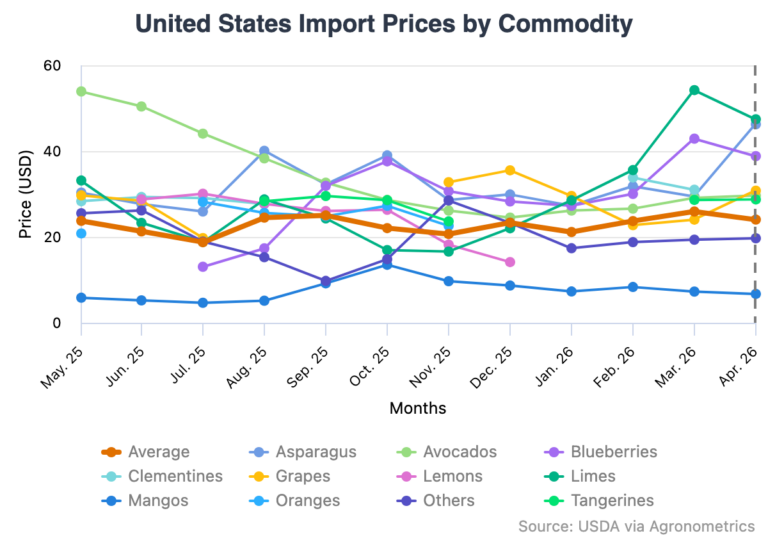
Source: USDA Market News via Agronometrics.
*The main image is referential. Graphs courtesy of Agronometrics.
Related stories
South African citrus shipments challenge geopolitical disruptions in the Middle East
Middle East conflict strains costs and global agricultural supply chains, Rabobank warns