Agronometrics in Charts: Growing global avocado supply brings greater uncertainty as market enters a new phase
 Add Fresh Fruit Portal to Google
Each week, the series ‘Agronometrics In Charts’ examines a different horticultural commodity, focusing on a specific origin or topic and visualizing the trade market factors driving change. Check out our entire archive.
The global avocado industry is entering a new phase of expansion, one characterized not only by rising production but also by greater uncertainty. While global demand continues to grow, climate change, geopolitical tensions, logistical disruptions and periods of oversupply are creating increasingly volatile market conditions.
According to a recent RaboResearch report, success in the years ahead will depend as much on managing risk as on increasing production.
Global avocado exports have grown more than fourfold over the past 15 years, rising from approximately 730,000 tons in 2010 to a projected 3.8 million tons by 2029. Mexico and Peru remain the dominant exporters, but countries such as Colombia, Kenya, Morocco, Spain, and South Africa are steadily increasing their presence in international markets.
This broader supplier base improves market resilience but also intensifies competition, particularly when several producing regions overlap in key destination markets.
The US is powering the avocado demand
The United States remains the world's largest avocado market, with record Mexican exports and a strong 2025/26 California crop pushing US avocado supply to historic highs.
The sharp increase in availability has marked a turnaround from the tighter conditions of the previous season, contributing to a normalization of prices, narrower price differences between fruit sizes, and continued premiums for organic avocados.
While Mexico remains the dominant supplier, Peru and Colombia continue to complement seasonal availability.
Looking ahead, RaboResearch expects the US market to be shaped by abundant supply, increasingly price-sensitive consumers, and policy uncertainty surrounding the US-Mexico-Canada Agreement (USMCA), all of which could influence future trade flows and pricing.
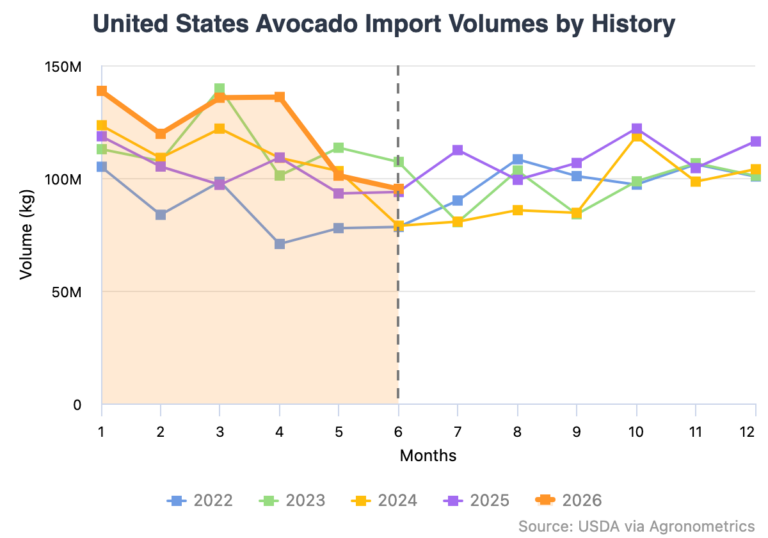
Source: USDA Market News via Agronometrics.
Europe remains a battlefield for avocado suppliers
Despite strong demand on both sides of the Atlantic, balancing supply throughout the year remains a challenge.
Europe experiences its largest influx of avocados during Peru's peak export season. In July 2025, EU imports exceeded 110,000 tons, equivalent to more than 6.5 million 8.8-pound boxes per week, compared with an average of around 4.4 million boxes during winter.
These seasonal peaks often place downward pressure on prices before recovering once Peruvian shipments decline, illustrating the importance of coordinated promotions and careful supply planning.
Southern Hemisphere is the global avocado engine
South America remains the engine of global avocado supply growth. The region exported more than one million tons for the first time in 2025, led by Peru, Colombia, and a recovering Chilean industry.
Peru remains on track to surpass one million tons of exports by 2030, while Colombia continues its rapid expansion, with exports expected to rise 16 percent during the 2025/26 season. Brazil is also emerging as a growing supplier, with exports forecast to increase by approximately 60 percent in 2026.
However, climate risks are making production increasingly unpredictable. El Niño conditions are expected to bring warmer and wetter weather to Peru, increasing the risks of disease pressure, fruit drop, quality issues, and variable fruit sizing. Colombia could experience warmer and drier conditions during critical flowering periods, potentially affecting yields and fruit quality.
For importers serving both European and US markets, greater variability in supply and quality is becoming an increasingly important consideration.
Africa is also strengthening its position within the global avocado trade.
Regional exports reached approximately 450,000 tons in 2025, up 16 percent from the previous year, with Kenya, Morocco, and South Africa remaining key suppliers while Tanzania and Burundi continue expanding their export presence.
Longer export windows are allowing African producers to play a larger role in supplying Europe's winter market and diversifying global supply.
Despite this growth, African exporters remain highly exposed to logistical disruptions. Shipping challenges affecting the Red Sea and Strait of Hormuz have increased freight costs and created additional uncertainty for exporters that rely heavily on overseas markets. Europe continues to account for the majority of African avocado exports, although shipments to India, China, and the Middle East have expanded in recent years.
Geopolitical pressure is stressing the supply chain.
Rising energy prices and higher costs for fertilizers, crop protection products, packaging, and transportation have increased production expenses across producing countries.
In Peru, imported fertilizer and crop protection product prices in May 2026 were reported to be 18 percent higher than in February, with overall avocado production costs expected to increase by around four percent year-over-year.
At the same time, disruptions in traditional export markets have forced some suppliers to redirect shipments, contributing to temporary oversupply and price declines in alternative destinations such as India.
Although global demand for avocados continues to expand, the industry's future will depend on more than simply producing larger volumes. As supply continues to grow, exporters, importers, and retailers will need to focus on diversification, flexible logistics, coordinated promotional campaigns, and year-round market planning.
For both the mature US market and Europe's expanding consumer base, balancing rising production with steady demand will be essential to maintaining stable prices and supporting long-term growth.
*All images are referential via Shutterstock | Graphs courtesy of Agronometrics.
The second edition of the Global Avocado Summit will be held on November 11, 2026, at the Monticello Casino Events Center in Santiago, Chile. Organized by Paltas de Chile and Yentzen Group, the meeting seeks to bring together the main players in a growing industry
The event has established itself as a key space for addressing commercial and sustainability issues in the industry, bringing together producers, exporters, buyers, certifiers, and innovators to analyze the sector’s challenges and opportunities.
For more info, contact events@yentzengroup.com
Related stories
Avocado set to become world's most traded tropical fruit by 2035