








Agronometrics in Charts: China's blueberry exports skyrocket 602 percent, transforming global trade



Each week, the series ‘Agronometrics In Charts’ looks at a different horticultural commodity, focusing on a specific origin or topic, and visualizing trade market factors that are driving change. Check out our entire archive.


China's blueberry export sector has undergone a dramatic transformation over the past three years.
Once almost entirely dependent on imports from South America, China is now growing into a significant exporter in its own right, while still importing large volumes of premium fruit that it cannot yet produce domestically at the quality levels its consumers demand.
Imports
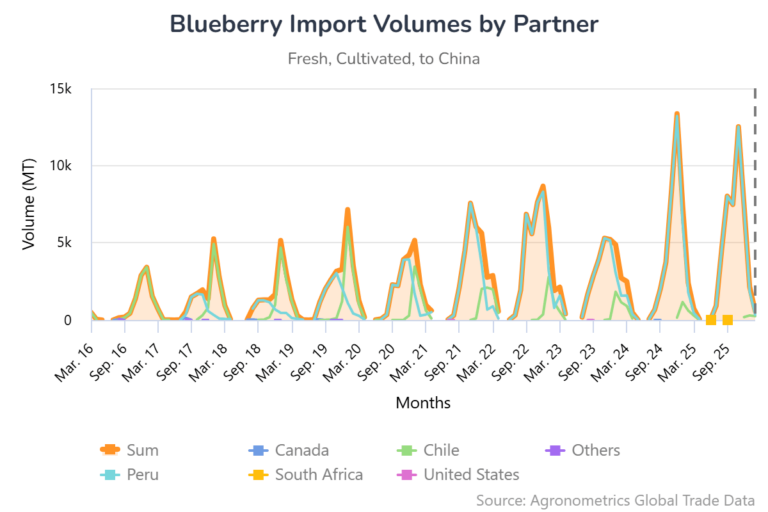
China began importing fresh blueberries in 2012. Currently, Peru and Chile account for virtually all of China's blueberry imports.
Peru closed 2025 with record global blueberry exports, with shipments to China surging 153 percent. The reason Peruvian fruit continues to perform well in China despite growing domestic competition is quality. Chinese urban consumers, particularly younger, health-conscious buyers, seek large, sweet, firm blueberries with high Brix levels, and Peruvian producers have invested heavily in varieties that meet exactly these preferences.
Chile, by contrast, saw its blueberry shipments to Asia fall seven percent in the 2025–26 season, driven primarily by lower volumes to China.
Source: USDA Market News via Agronometrics. (Agronometrics users can view this chart with live updates here)
China's blueberry exports on the rise
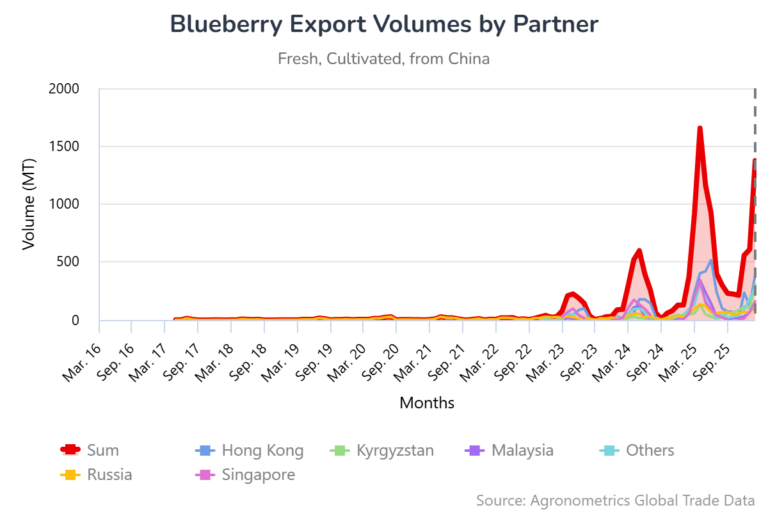
The more striking development is on the export side. China first shipped fresh blueberries abroad in 2020, when it exported just 113 metric tons—almost entirely to Russia.
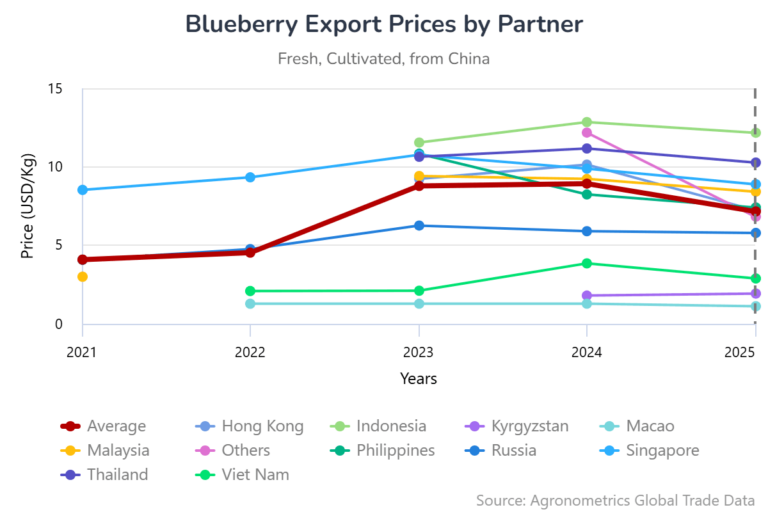
Between 2023 and 2025, China's blueberry exports grew from 1,011 tons to 7,098 tons, extending its season and widening its market reach across Asia and parts of Eurasia. Total export value reached $50.82 million in 2025, with a weighted average price of approximately $7.16 per kilogram.
The top destinations in 2025 were Hong Kong (2,395 MT), Russia (868 MT), Malaysia (1,128 MT), and Singapore (928 MT). Kyrgyzstan emerged as a significant new market, importing 706 metric tons in 2025, compared with none in 2023.
Pricing varied dramatically by destination. Indonesia paid an average of $12.16 per kilogram and Thailand $10.26 per kilogram, reflecting demand for premium fruit in those markets. At the other end, Macau averaged just $1.12 per kilogram and Kyrgyzstan $1.93 per kilogram.
"The widespread adoption of evergreen blueberry varieties, which require little to no chilling, has extended fruiting periods, enhanced quality, and expanded market sales," said Wu Lin, chairman of the small fruit branch of the Chinese Society for Horticultural Science, to media outlet ChinaDaily. He added that substrate cultivation techniques have transformed traditional growing methods and allowed for expansion into new regions.
Wu said the industry has been shifting from a quantity-driven approach, focused on rapid expansion and high yields, to a quality-oriented strategy that prioritizes fruit quality and premium pricing.
Source: USDA Market News via Agronometrics. (Agronometrics users can view this chart with live updates here)
Source: USDA Market News via Agronometrics. (Agronometrics users can view this chart with live updates here)
China's blueberry market is becoming more selective and is consolidating around quality. The exporters who will sustain their position in China are those offering consistent premium fruit: large caliber, high brix, long shelf life, and reliable cold chain.
China's blueberry industry is beginning to compete with South American exporters in third markets, particularly Southeast Asia and Russia. This is an early-stage dynamic, but the 602 percent export growth rate between 2023 and 2025 and an increased focus on quality signal that it might not stay early-stage for long.
Related articles:
The new China: US pistachios ready to crack India’s high-growth market






Subscribe to our newsletter