



Each week, the series ‘Agronometrics In Charts’ examines a different horticultural commodity, focusing on a specific origin or topic and visualizing the trade market factors driving change. Check out our entire archive.
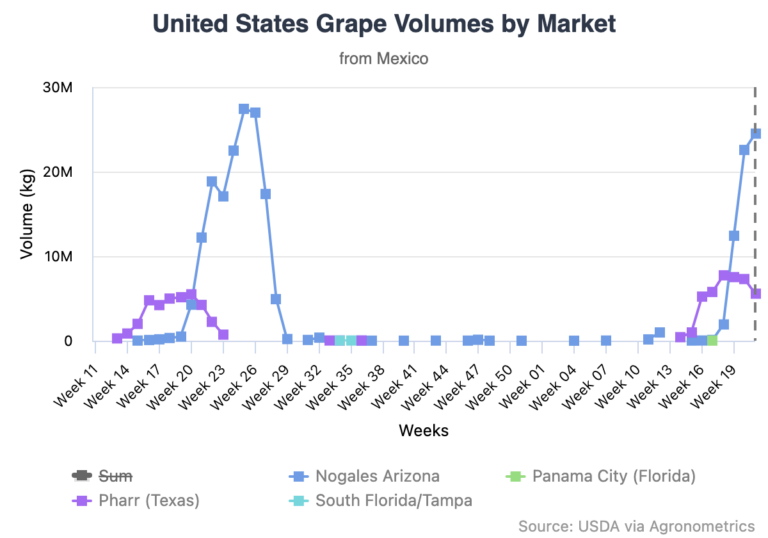
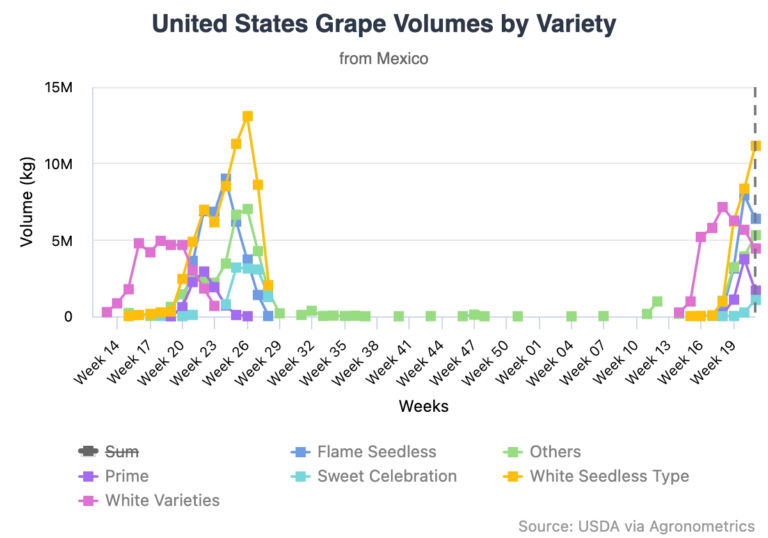
The 2026 Mexican grape season is progressing faster than normal, with lower-than-expected yields prompting a significant reduction in crop forecasts and an earlier end to shipments. John Pandol, at Pandol Bros. of Delano, California, told Fresh Plaza that harvest in Sonora, Mexico, began roughly two weeks ahead of schedule in late April and is expected to finish about two weeks earlier than usual.
Shipments from Nogales, Arizona, are projected to conclude before July 3, shortening the season's marketing window.
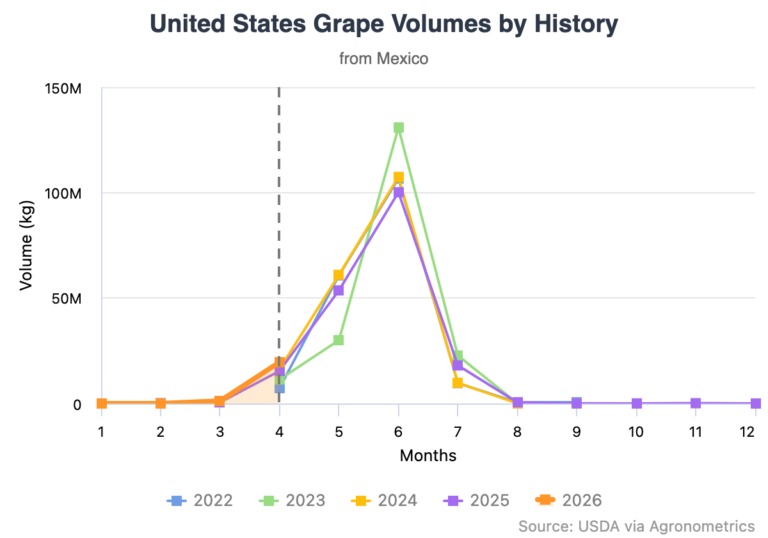
As of May 19, approximately one-third of the crop had been harvested. While growers entered the season expecting lower production than last year, volume estimates have continued to decline as harvest progresses. The initial pre-season forecast called for 18.2 million cartons, down from 22.7 million cartons in 2025.
However, revised estimates now place production in the 15-16 million-carton range.
Source: USDA Market News via Agronometrics.
Source: USDA Market News via Agronometrics.
Growing conditions throughout Mexico have contributed to reduced production. Industry sources report that warmer-than-normal winter and spring weather accelerated crop development but led to fewer bunches per vine, thereby limiting overall volume. While yields have fallen short of expectations, growers remain optimistic about fruit quality, noting that berry size and eating quality have generally been strong.
Production challenges were not limited to Sonora. In the southern growing region of Jalisco, periods of rain and elevated humidity reduced yields and led to crop losses in some vineyards. Growers say the experience has highlighted the importance of additional protective measures, including expanded use of plastic coverings in vulnerable production areas.
Despite lower overall production, the season has also showcased continued innovation in grape breeding and variety development. Growers reported encouraging results from recently introduced early-season seedless varieties designed to deliver improved sweetness, texture, appearance, and post-harvest performance. Industry participants say advances in breeding are helping overcome long-standing challenges associated with early-season grapes, particularly in achieving strong flavor and crunch while maintaining shipping quality.
Some of these newer varieties also offer operational benefits for growers, including more uniform maturity and the potential for fewer harvest passes. The introduction of improved early-season varieties reflects broader industry efforts to extend marketing opportunities and deliver more consistent quality throughout the season.
Source: USDA Market News via Agronometrics.
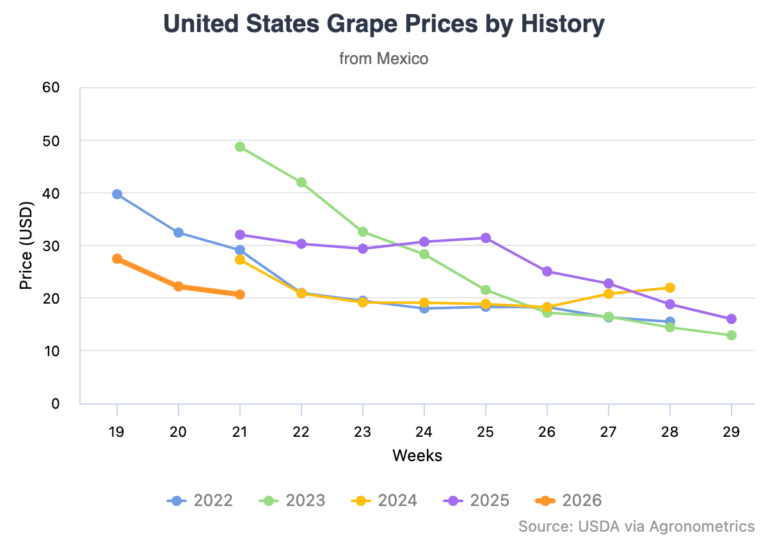
Despite reduced Mexican production, pricing has remained relatively soft. According to industry sources, buyers continue to look ahead to the start of California's San Joaquin Valley grape harvest, expected between June 20 and June 25. Market preference continues to shift toward newer proprietary grape programs, which now account for the majority of Mexico's production. These varieties are increasingly favored for their flavor, texture, shelf life, and consumer appeal, while traditional varieties continue to represent a smaller share of the crop.
Demand remains particularly strong for premium, high-quality green seedless grapes, with retailers continuing to emphasize varieties that offer consistent eating quality and extended shelf life.
Source: USDA Market News via Agronometrics.
The 2026 season is being defined by lower yields, reduced production forecasts, and a compressed shipping window. While the smaller crop could help balance supply and demand later in the season, industry leaders caution that reduced volume alone does not guarantee stronger market conditions. As harvest nears completion and attention shifts to California, growers and marketers remain focused on maintaining disciplined shipping programs and maximizing quality in the final weeks of the Mexican season.
At the same time, continued investment in improved grape varieties and production practices suggests the industry is positioning itself for long-term growth despite the challenges presented by weather and changing growing conditions.
*Images are referential | Graphs courtesy of Agronometrics.
On August 12, 2026, Monticello Conference Center, in Santiago, Chile, will host a new edition of the Global Grape Convention.
Organized by Yentzen Group, Frutas de Chile, Provid, Global Grape Group, and Mexico Table Grapes, the event will bring together leading international experts in an unmissable day of strategic content, key trends, and high-level analysis to anticipate market challenges.
The convention is a unique platform to connect with buyers, distributors, exporters, and retail leaders, generating real business opportunities and strengthening networks in a highly specialized environment.
For more info, contact events@yentzengroup.com
Tickets available at globalgrapeconvention.com
Related stories
Mexican table grape season makes early debut, squeezing market prices
Oppy doubles Mexican grape volume and looks to expand in Asia