



Each week, the series ‘Agronometrics In Charts’ examines a different horticultural commodity, focusing on a specific origin or topic and visualizing the trade market factors driving change. Check out our entire archive.
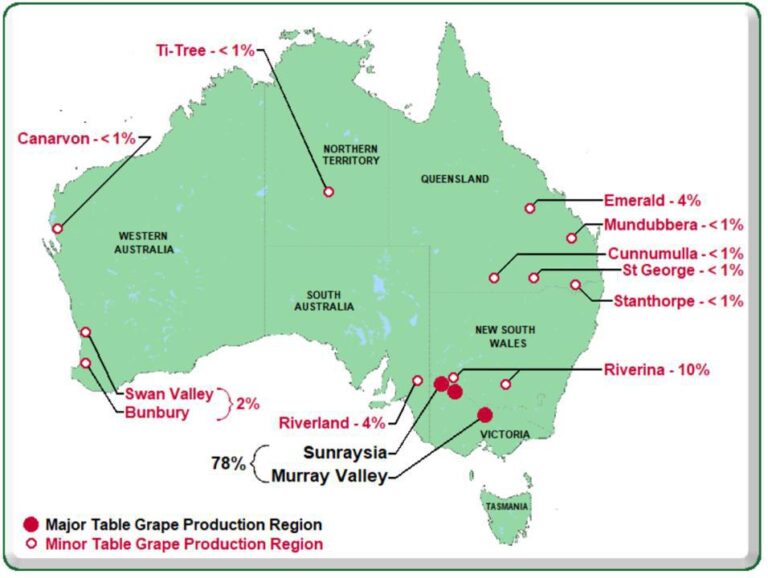
The Australian table grape industry is primarily concentrated in the northern region of the state of Victoria, around Mildura (Sunraysia), where nearly 70 percent of the country's vineyard area is located. Thanks to its dry summer climate, this region has built a strong reputation for producing premium-quality fruit for export markets. Its primary destination is Asia, particularly China, a market that has historically demanded exceptionally high standards of quality, condition, and presentation.
These demanding requirements have driven the Australian table grape industry to develop a production model centered on excellence. However, the 2025/26 season once again demonstrated that even the most established production systems remain vulnerable to extreme weather events and their effects on grapevine physiology.
The season began with unusually heavy spring rainfall, coinciding with critical stages of bunch development. These rains increased disease pressure, affected fruit set, and resulted in greater variability in berry development. From a physiological perspective, the vines were forced to allocate a significant portion of their energy toward responding to environmental stress, compromising key processes required to produce uniform, high-quality fruit.
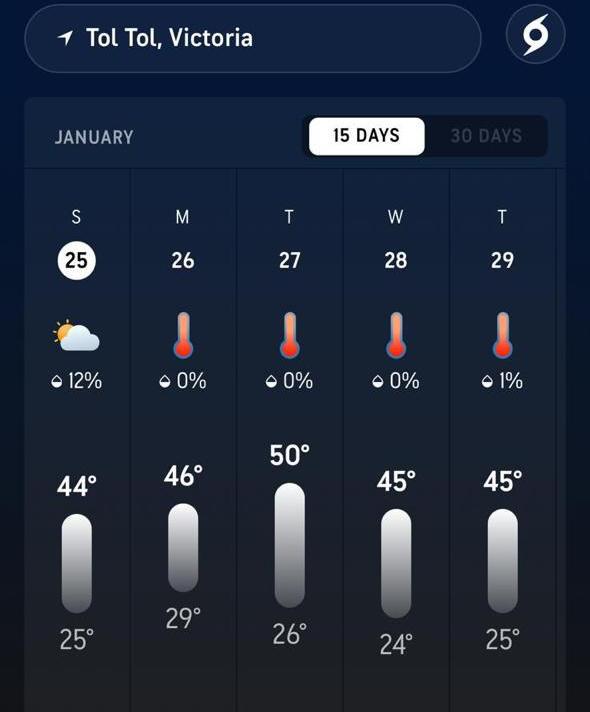
As vineyards approached harvest, a series of heat waves significantly increased physiological stress on the vines. Higher Vapor Pressure Deficit (VPD) intensified the atmosphere's evaporative demand, promoting stomatal closure, reducing photosynthesis, and limiting the production of photoassimilates. Consequently, the vines' ability to sustain berry growth and hydration declined precisely during the stage when final fruit quality is determined.
As a result, fruit condition became the Australian table grape industry's primary commercial challenge during the season. Numerous export shipments exhibited rachis dehydration, reduced berry firmness, shorter postharvest life, and difficulties in meeting the quality standards required by international markets. For an industry accustomed to satisfying the demanding expectations of Asian buyers—particularly Chinese consumers—this season proved that, in many cases, the expected level of fruit quality simply could not be achieved. This translated into greater commercial discounts and significant economic losses for many growers.
Australian table grape export volume was considerably affected, as shown on the graph
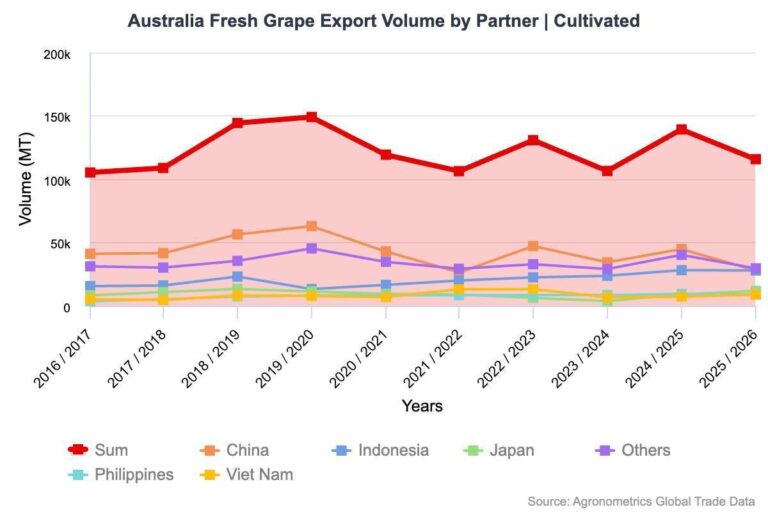
Source: USDA Market News via Agronometrics.
Beyond the immediate impact of this season, the Australian experience reinforces a trend that is becoming increasingly evident across grape-producing regions worldwide: climate variability is no longer an exceptional event but a permanent component of modern vineyard management. Understanding how grapevines physiologically respond to excessive rainfall, elevated temperatures, and atmospheric stress will become increasingly critical for maintaining productivity and, above all, preserving fruit quality.
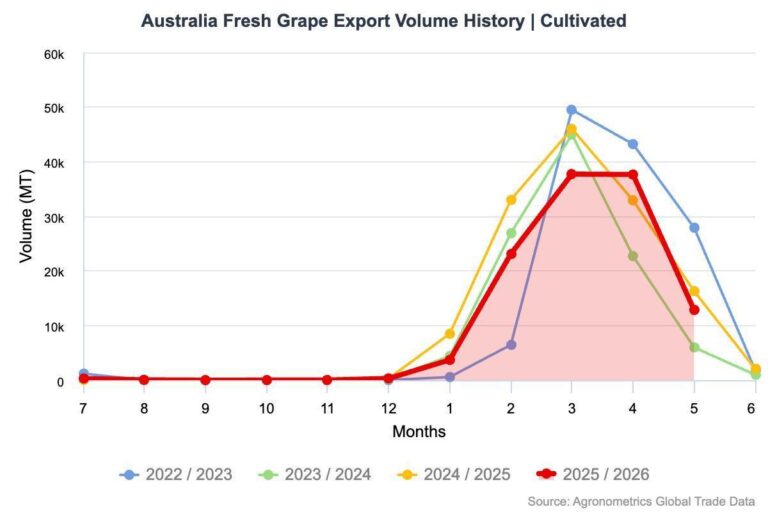
Source: USDA Market News via Agronometrics.
The Australian table grape season delivers a clear message to the industry: achieving high yields is no longer enough. Future profitability will increasingly depend on the ability to anticipate the impact of climatic events, interpret the physiological signals of the crop, and make timely management decisions that protect fruit condition from the vineyard through to the final market. In an era of increasing climate uncertainty, plant physiology is no longer merely an academic discipline—it has become a strategic tool for improving vineyard management, protecting fruit quality, and sustaining profitability.
The challenge of the Australian table grape industry is to maintain profitability through a more precise nutritional and physiological management approach, carefully tailored to the local conditions of each vineyard, while consistently aiming to achieve the best possible varietal expression. We must remember that fresh fruit is now available in the market every week of the year. Quality alone no longer guarantees market access—but the absence of quality will certainly leave you out.
*Main image is referential via Unsplash | Graphs courtesy of Agronometrics
On August 12, 2026, Monticello Conference Center, in Santiago, Chile, will host a new edition of the Global Grape Convention.
Organized by Yentzen Group, Frutas de Chile, Provid, Global Grape Group, and Mexico Table Grapes, the event will bring together leading international experts in an unmissable day of strategic content, key trends, and high-level analysis to anticipate market challenges.
The convention is a unique platform to connect with buyers, distributors, exporters, and retail leaders, generating real business opportunities and strengthening networks in a highly specialized environment.
For more info, contact events@yentzengroup.com
Tickets available at globalgrapeconvention.com
Related stories
Tight Australian supplies keep apple prices up
How Australian table grapes cracked the code to China exports—and almost lost it all