



While table grape production and consumption continue to rise in Asia, the coveted Chinese market is facing a massive shift. Daniel Ho, co-founder and commercial director of Shanghai Topsun Fresh, warns that international shippers will need to adapt to a shrinking share of the once-reliable market.
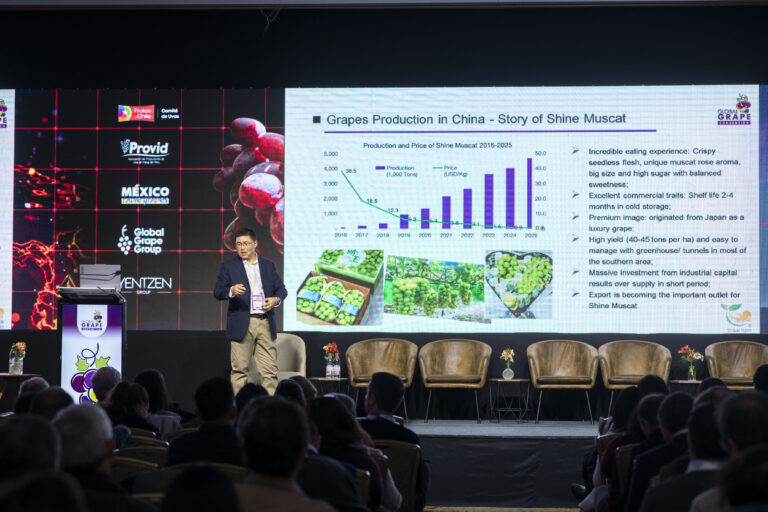
During his presentation at the Global Grape Convention 2026, held in Santiago, Chile, on August 12th, Ho said imported table grapes account for less than one percent of China’s total consumption, making the country’s import market significantly more specialized than its size might suggest.
The key, Ho stressed, is now quality over quantity. In his view, overseas growers must pivot away from mass volume and target the small fraction of Chinese consumers willing to pay top dollar for an exceptional eating experience.
“The market is there,” Ho said. “People are willing to pay two or three times more for the freshness, good flavor, and superior eating experience.”
Asia dominates global fresh table grape consumption, with a 65 percent market share accounting for 22 million tons in 2025. The region’s per capita rate is 16.3 pounds, surpassing both Europe and the United States. Meanwhile, neighboring India is the second-largest consumer, with an eight percent global share and a per capita consumption of 4.2 pounds.
In 2025, China was responsible for half of the table grapes harvested that year (15 million tons), a number that has been growing continuously over the past six years, a period in which the country’s industry expanded by 31 percent.
This surge consequently triggered a massive reduction in shipments from traditional trade partners. Over the last decade, Chinese grape imports dropped by nearly 60 percent to 110,000 tons.

"In terms of the total consumption, [imported grapes are] less than one percent," Ho said. "That means all the imported fruits are not for everyone. Only a small group of people can afford imported fruit."
The executive noted that the target demographic for these top-tier imports consists primarily of educated women between 25 and 45 years old who make household purchasing decisions. These buyers demand high sugar levels, low acidity, zero astringency, zero skin friction, and visual indicators of freshness, such as intact bloom and bright green stems.
The primary catalyst behind China's shifting market dynamics is the explosion of Shine Muscat production, Ho explained. Over 10 years, Chinese output of the variety surged 70-fold, rising from 77,000 tons to 5.2 million tons.
This massive volume shift virtually crushed grower returns: a variety that a decade ago fetched $18 per pound at the farmgate now can be purchased for under 45 cents per pound.

The domestic surplus forced Chinese suppliers to ramp up exports, nearly doubling overseas shipments over six years to 928,000 tons. Approximately 93 percent of Chinese exports go to other Asian nations, with 75 percent heading to Southeast Asian countries under trade agreements like the Association of Southeast Asian Nations (ASEAN) and the Regional Comprehensive Economic Partnership (RCEP).
Under this high-volume environment, Chilean and Peruvian import shipments into China both dropped by roughly 70 percent compared to a decade ago. However, Peru captured a 34 percent increase in cost, insurance, and freight (CIF) prices last season, whereas Chilean prices remained flat.
Australia maintained stable pricing and consistent demand due to strict post-harvest protocols, despite multi-port ocean transit delays averaging 31 days.
To meet these high standards and overcome such obstacles, Ho insists on a much more hands-on approach.
"They want flavor. We have our own people stay on the farms and talk with our partners here," Ho explained regarding his team's field presence in supply regions. "We send our own team from China to taste the fruit and work with our partners, saying, 'Okay, guys, please wait another week.' That is how we operate now. The point is that it works."

To beat sea freight delays and deliver the stellar quality Chinese buyers demand, Ho’s Shanghai Topsun Fresh moved 4.4 million pounds of table grapes by air last season. The company chartered five Boeing 777 flights per week, each carrying a 110-ton capacity.
Ho emphasized that success in the current environment requires foreign growers to change their approach drastically.
"Capturing even one percent of this market is sufficient for all the growers and exporters present," Ho said. "First, we must rethink our approach to the Chinese market. Second, we have to actively work for it, which may require sacrificing some yield to prioritize superior flavor."
The Global Grape Convention 2026, organized by Yentzen Group, Frutas de Chile, Provid, and Mexico Table Grapes, brought together 900 people and over 50 sponsoring companies.
*Don't miss all the details of the Global Grape Convention 2026 on our social media and at FreshFruitPortal.com.*
*Para cobertura en español, siga a Portalfruticola.com*
Related stories