



Each week, the series ‘Agronometrics In Charts’ examines a different horticultural commodity, focusing on a specific origin or topic and visualizing the trade market factors driving change. Check out our entire archive.
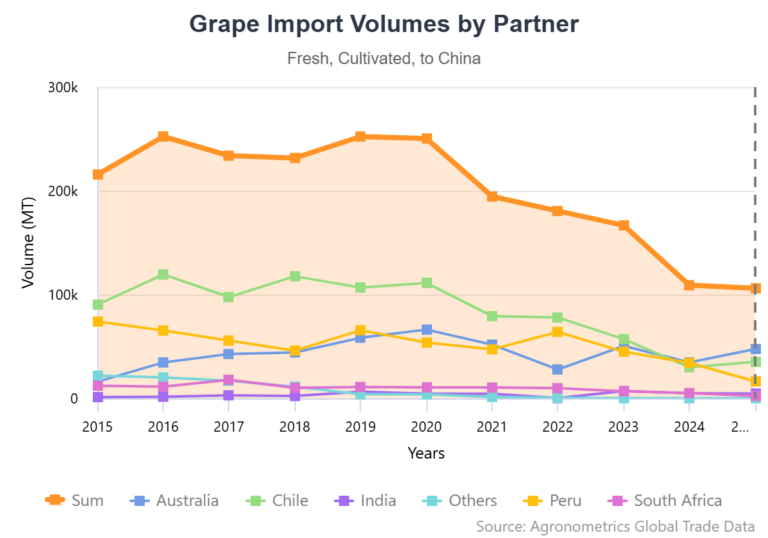
For most of the past two decades, China's role in the global table grape trade was straightforward: the world's largest producer, consuming nearly everything it grew domestically while supplementing its supply with imports from Chile, Peru, Australia, and South Africa.
Source: USDA Market News via Agronometrics.
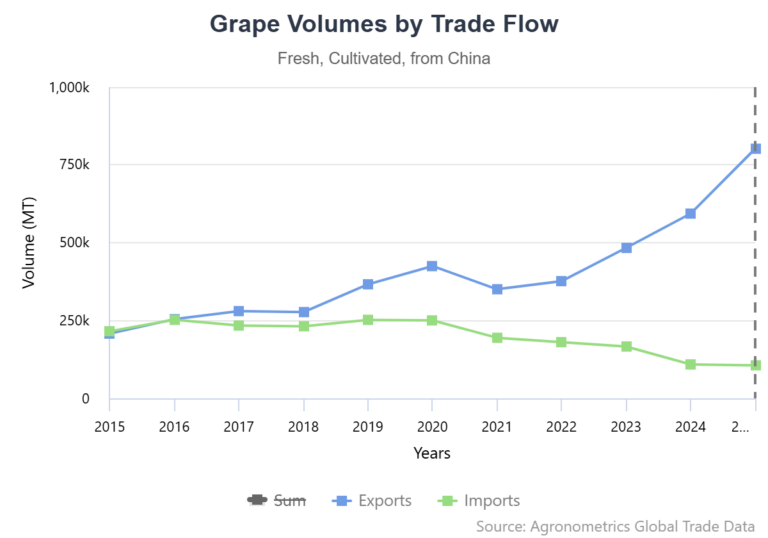
That changed in 2016, when China became a net exporter for the first time. Shipments have grown consistently ever since, declining only once, in 2021, reaching over 800,00 metric tons in 2025, enough to draw level with Peru for the first time.
Imports have moved in the opposite direction: just 106,152 metric tons in 2025, down from 250,483 metric tons in 2020.
The engine behind both trends is the same: seven consecutive years of production growth have pushed output to 15 million metric tons, driven by yield gains from controlled growing environments rather than new plantings, according to Rabobank.
China's compound annual export growth rate of 12 percent over the past decade is the highest among exporting countries, ahead of Peru's 10 percent.
Source: USDA Market News via Agronometrics.
For the origins that previously supplied China, this dual shift is the central commercial challenge of the decade.
As domestic production covers more of the calendar year, the import window that those origins relied on is narrowing. At the same time, China's exports increasingly compete in the same Southeast Asian markets that Southern Hemisphere exporters had eyed for diversification. Of the 638,073 metric tons imported into Southeast Asia in 2025, 87 percent came from China alone, according to Agronometrics' Global Trade Data, leaving little room for long-haul origins to compete on cost.
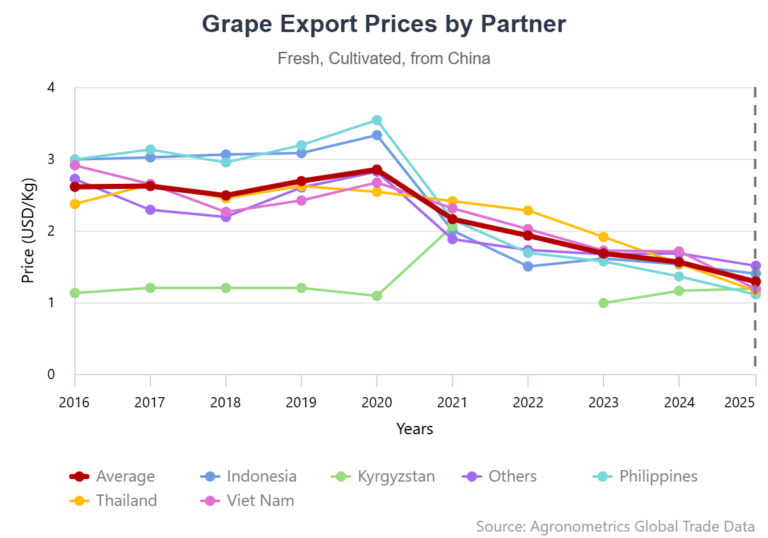
What complicates the growth story is price. Chinese grape export prices fell from $2.85/kg in 2020 to $1.29/kg in 2025, a decline of more than 50 percent, pressuring margins just as production costs rose.
Source: USDA Market News via Agronometrics.
Yet total export value over the same period tells a different story: after dipping to $757 million in 2021, export value climbed steadily to $1.035 billion in 2025, an increase of nearly 37 percent. The combination is only possible because volume growth has more than offset the price collapse, confirming that China's export growth has been driven by sheer scale rather than value capture.
The root cause appears to be structural oversupply: certain popular table grape varieties were planted so aggressively that farm-gate prices in parts of China collapsed sharply by early 2026, according to FreshPlaza, with growers reporting that the rising planted area has outpaced what the market can absorb.
Whether China's varietal upgrade, a shift toward newer, higher-value genetics that some industry analysts have flagged, will be enough to reverse this price trend remains an open question.
The charts in this article are drawn from Agronometrics' Global Trade Data, an interactive platform covering table grape export and import volumes, prices, and values for every country in the world, with over 10 years of historical data. If you'd like to explore the data yourself, reach out to book a demo.
On August 12, 2026, Monticello Conference Center, in Santiago, Chile, will host a new edition of the Global Grape Convention.
Organized by Yentzen Group, Frutas de Chile, Provid, Global Grape Group, and Mexico Table Grapes, the event will bring together leading international experts in an unmissable day of strategic content, key trends, and high-level analysis to anticipate market challenges.
The convention is a unique platform to connect with buyers, distributors, exporters, and retail leaders, generating real business opportunities and strengthening networks in a highly specialized environment.
For more info, contact events@yentzengroup.com
Tickets available at globalgrapeconvention.com
Related stories
Decoding the "new normal": How exporters can unlock growth in China’s evolving consumer market