




Each week, the series ‘Agronometrics In Charts’ examines a different horticultural commodity, focusing on a specific origin or topic and visualizing the trade market factors driving change. Check out our entire archive.
This note complements an earlier piece on China's rise as a global table grape exporter, which covered the volume dynamics behind the simultaneous collapse in imports and surge in exports. The focus here is narrower: what has happened to price, and what it reveals about the structure of China's grape market.
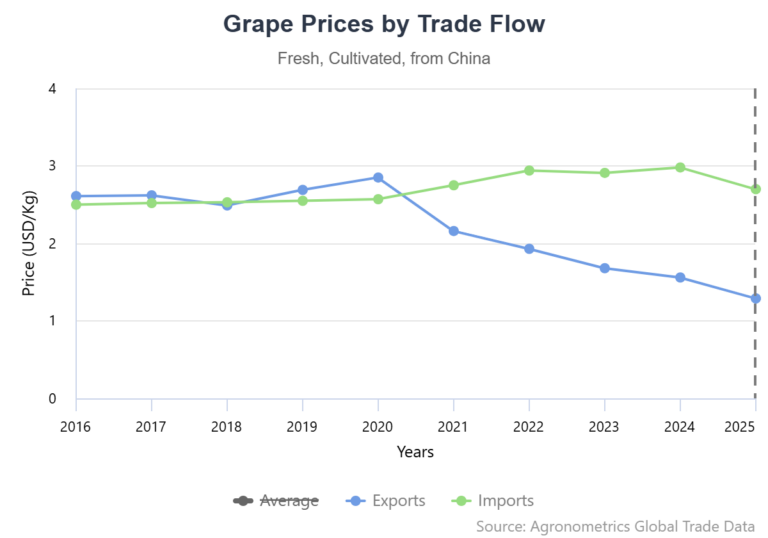
For most of the period from 2016 to 2020, the price of table grapes entering China and the price of table grapes leaving it were broadly the same. According to Agronometrics' Global Trade Data, the average CIF import price into China held between $1.13 and $1.17 per pound across those years, while the average FOB export price ranged from $1.13 to $1.29 per pound, the two moving in parallel, at rough parity.
Then, in 2021, the two lines diverged. Export prices fell sharply from $1.29 per pound to $0.98 per pound in a single year, a 24 percent drop, while import prices simultaneously rose to $1.25 per pound, their highest level in at least half a decade. That crossover marks the moment China's grape market split structurally in two. By 2025, the gap had widened to a ratio of more than 2:1: import CIF at $1.22 per pound, export FOB at $0.59 per pound.
Source: USDA Market News via Agronometrics.
The mechanism behind the export price collapse is well documented. The USDA FAS Beijing Attaché Report (November 2024) confirms that China's export surge has been driven by falling domestic grape prices, noting that prices for certain widely planted varieties collapsed as rapid area expansion outpaced market absorption, as further detailed by Produce Report.
The dynamic is self-reinforcing: falling domestic prices push growers to export rather than sell locally, increasing export volume without improving export value and confirming that China's position as a global top-two exporter is built on scale, not price leadership. Total export value grew from $757 million in 2021 to $1.035 billion in 2025, but only because volume growth more than offset the price decline.
What is less widely noted is what happened on the import side of the ledger over the same period. While total import volume fell by 58 percent between 2020 and 2025, from 276,108 to 117,012 short tons, the average import price did not fall. It rose, from $1.17 per pound in 2020 to $1.22 per pound in 2025. The fruit that remains in China's import program commands more per pound than ever, even as volume shrinks.
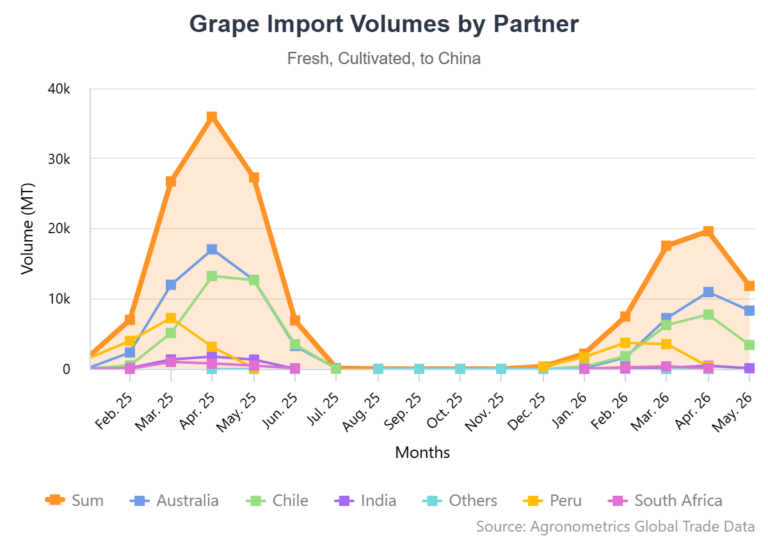
This is not a market in decline; it is a market that is concentrating around quality. Imported grapes now serve a specific and narrow function: meeting premium consumer demand during China's domestic off-season, concentrated almost entirely between January and May, per the USDA FAS Beijing Attaché Report, a pattern confirmed by Agronometrics' monthly import volume data.
Source: USDA Market News via Agronometrics.
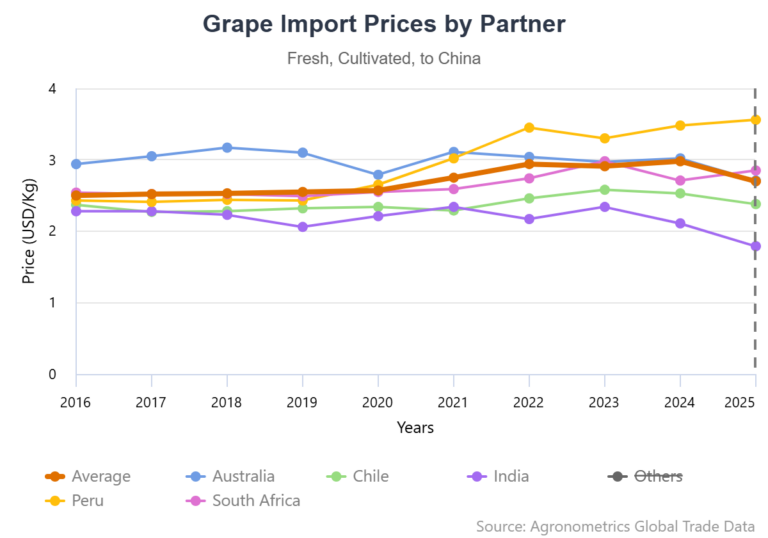
The origin-by-origin breakdown makes the two-tier structure explicit. Peru is the clearest example: import volume from Peru fell 70 percent between 2020 and 2025, from 59,335 to 18,039 short tons, yet the CIF import price rose 34 percent, from $1.20 per pound to $1.61 per pound. In the 2021/22 season, China was already paying $1.35 per pound for Peruvian grapes, more than the $1.00 per pound that Peruvian exporters were achieving in the Netherlands at the same time, according to Produce Report, making China their most valuable destination by unit price despite ranking third by volume.
By 2023/24, that price had risen further to $1.47 per pound, placing Peru in what Produce Report described as "the highest price bracket" among all origins shipping to China. Peru is selling less to China and being paid more for it. Australia tells a similar story: import volume down 28 percent but price broadly held, with Australian industry actively rejecting price competition as a strategy—"competing solely on price isn't an option," its industry representative Jeff Scott told FreshFruitPortal in June 2026.
Chile, by contrast, lost 68 percent of its China volume with limited price improvement, displaced from the mid-range segment by domestic Chinese production without having repositioned upmarket. South Africa has effectively exited the market, down 78 percent in volume to just 2,627 short tons in 2025, per Agronometrics' Global Trade Data.
Source: USDA Market News via Agronometrics.
China's import window, already confined to the January–May off-season, is being compressed from both ends, as investments in controlled growing environments and post-harvest storage continue to push domestic supply further into months that previously belonged to counter-seasonal importers, per the USDA FAS Beijing Attaché Report.
What remains is an increasingly short, increasingly premium window: the months when domestic Chinese fruit is genuinely unavailable and affluent urban consumers are willing to pay above $1.22 per pound for counter-seasonal imports that domestic production cannot yet replicate in quality or variety. For exporters still active in China, the commercial question is no longer how to grow volume—it is how to stay on the right side of that quality threshold as the window continues to compress.
*Top photo is referential via Shutterstock. | Graphs courtesy of Agronometrics.
On August 12, 2026, Monticello Conference Center, in Santiago, Chile, will host a new edition of the Global Grape Convention.
Organized by Yentzen Group, Frutas de Chile, Provid, Global Grape Group, and Mexico Table Grapes, the event will bring together leading international experts in an unmissable day of strategic content, key trends, and high-level analysis to anticipate market challenges.
The convention is a unique platform to connect with buyers, distributors, exporters, and retail leaders, generating real business opportunities and strengthening networks in a highly specialized environment.
For more info, contact events@yentzengroup.com
Tickets available at globalgrapeconvention.com
Related stories