



Each week, the series ‘Agronometrics In Charts’ examines a different horticultural commodity, focusing on a specific origin or topic and visualizing the trade market factors driving change. Check out our entire archive.
The US table grape market is experiencing a shift in its supply transition timing.
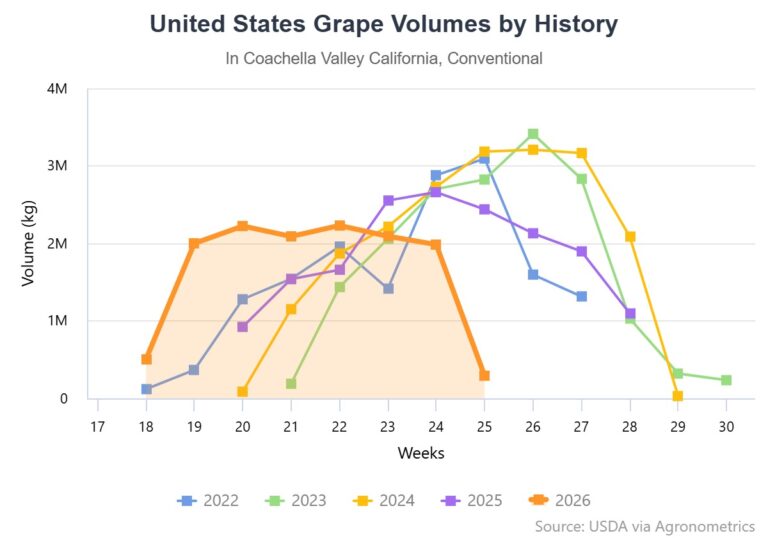
Historical data indicate that California's Coachella Valley advanced its production curve during the current 2026 campaign, shortening the marketing window for imported counter-season fruit.
During the winter, the US supply is structured complementarily: Peru supplies the early window in December, and Chile follows in February and March with new seedless varieties. The closure of this import cycle and the start of inflows from Mexico depend on the date when US domestic volume begins to enter the market.
In 2026, this transition period was notably reduced. Coachella Valley had an early and significant harvest: the first volume records occurred in week 18, and by week 19, the local sector was already contributing 2 million kilograms per week.
In previous seasons (2023 or 2024), this level of domestic supply did not materialize until weeks 22 or 23.
Source: USDA Market News via Agronometrics.
This early availability of Californian grapes in May occupied distribution channels, tempering demand for late Southern Hemisphere shipments.
Coachella Valley's production maintained a steady flow exceeding 2 million kilograms for four consecutive weeks, stabilizing the domestic supply and limiting market space for imported fruit.
Its 2026 production advancement was driven by an unusually warm winter that accelerated plant metabolism, compressing the flowering and fruit ripening stages. This climatic factor was compounded by the entry into full production of new, extra-early patented varieties genetically designed to concentrate high volumes in less time.
As of the current week 24, Coachella Valley's curve shows a sharp decline, sitting near one million kilograms weekly. By accelerating its cycle, the valley concludes its run earlier than anticipated, prompting an immediate handoff to the San Joaquin Valley.
For the upcoming 2027 season, production curves are anticipated to normalize and return to their usual behavior due to the expected return of statistical climate averages and the need to mitigate the physiological wear on the vineyards following a highly demanding cycle.
However, this evolution demonstrates that windows for foreign grapes tend to become tighter, requiring greater international logistical coordination to avoid overlapping with US domestic production.
*All images are referential; graph courtesy of Agronometrics.
On August 12, 2026, Monticello Conference Center, in Santiago, Chile, will host a new edition of the Global Grape Convention.
Organized by Yentzen Group, Frutas de Chile, Provid, Global Grape Group, and Mexico Table Grapes, the event will bring together leading international experts in an unmissable day of strategic content, key trends, and high-level analysis to anticipate market challenges.
The convention is a unique platform to connect with buyers, distributors, exporters, and retail leaders, generating real business opportunities and strengthening networks in a highly specialized environment.
For more info, contact events@yentzengroup.com
Tickets available at globalgrapeconvention.com
Related stories
California table grape season: San Joaquin Valley fruit is ready for the relay
Opinion | Why Southern Hemisphere table grapes remain an attractive (though challenging) business